
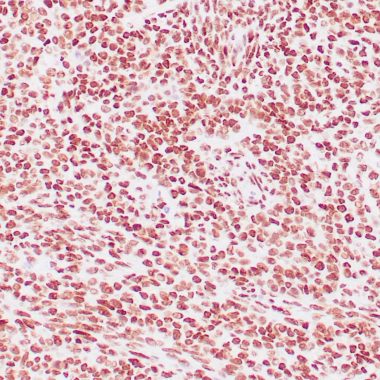

Anti-TLE1 antibody (175-338aa) [ZM93] (STJ180329)
SPECIFICATIONS
ClonalityMonoclonal
HostMouse
ConjugationUnconjugated
IsotypeIgG2ak
ImmunogenRecombinant human TLE1 fragment (aa 175-338)
General Information
| Short Description | Mouse monoclonal TLE1 (175-338aa) antibody for use in IHC-P in human samples. Datasheet included with dilution recommendations, and related reagents. |
| Applications | IHC-P |
| Host | Mouse |
| Reactivity | Human |
| Note | STRICTLY FOR FURTHER SCIENTIFIC RESEARCH USE ONLY (RUO). MUST NOT TO BE USED IN DIAGNOSTIC OR THERAPEUTIC APPLICATIONS. |
Product Properties
| Clonality | Monoclonal |
| Clone ID | ZM93 |
| Isotype | IgG2ak |
| Conjugation | Unconjugated |
| Purification | Affinity purified |
| Dilution Range | 1:100‐200 |
| Formulation | Tris-HCI buffer containing stabilizing protein (BSA) and <0.1% ProClin |
| Storage Instruction | Store at 2‐8°C for up to 24 months. Predilute: Ready to use, no reconstitution necessary. Concentrate: Use dilution range and appropriate lab‐standardized diluent. Stability after dilution: 7 days at 24°C, 3 months at 2‐8°C, 6months at ‐20°C. |
Target Information
| Gene Symbol | TLE1 |
| Gene ID | 7088 |
| Uniprot ID | TLE1_HUMAN |
| Immunogen | Recombinant human TLE1 fragment (aa 175-338) |
| Immunogen Region | 175-338aa |
| Specificity | Positive control: Synovial sarcoma |
Additional Info
| Tissue Specificity | In all tissues examined, mostly in brain, liver and muscle. |
| Post Translational Modifications | Phosphorylated, probably by CDK1. The degree of phosphorylation varies throughout the cell cycle, and is highest at the G2/M transition. Becomes hyperphosphorylated in response to cell differentiation and interaction with HES1 or RUNX1. Ubiquitinated by XIAP/BIRC4. |
| Function | Transcriptional corepressor that binds to a number of transcription factors. Inhibits NF-kappa-B-regulated gene expression. Inhibits the transcriptional activation mediated by FOXA2, and by CTNNB1 and TCF family members in Wnt signaling. Enhances FOXG1/BF-1- and HES1-mediated transcriptional repression. The effects of full-length TLE family members may be modulated by association with dominant-negative AES. Unusual function as coactivator for ESRRG. |
| Protein Name | Transducin-Like Enhancer Protein 1E(Sp1 HomologEnhancer Of Split Groucho-Like Protein 1Esg1 |
| Database Links | Reactome: R-HSA-201722Reactome: R-HSA-2122947Reactome: R-HSA-3769402Reactome: R-HSA-4641265 |
| Cellular Localisation | NucleusNuclear And Chromatin-AssociatedDepending On Isoforms And Phosphorylation StatusHyperphosphorylation Decreases The Affinity For Nuclear Components |
| Alternative Antibody Names | Anti-Transducin-Like Enhancer Protein 1 antibodyAnti-E(Sp1 Homolog antibodyAnti-Enhancer Of Split Groucho-Like Protein 1 antibodyAnti-Esg1 antibodyAnti-TLE1 antibody |
Information sourced from Uniprot.org