

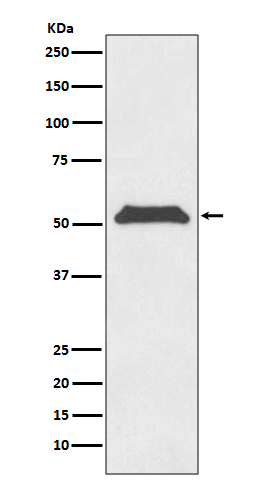

Anti-TERF1 antibody [R05-4G3] (STJA0036304)
SPECIFICATIONS
ClonalityMonoclonal
HostRabbit
ConjugationUnconjugated
IsotypeIgG
ImmunogenA synthesized peptide derived from human TRF1
General Information
| Short Description | Rabbit monoclonal anti-TERF1 for use in WB, ICC and IF in Human and Mouse samples. Datasheet included with dilution recommendations, and related reagents. |
| Applications | WB/ICC/IF |
| Host | Rabbit |
| Reactivity | Human/Mouse |
| Note | STRICTLY FOR FURTHER SCIENTIFIC RESEARCH USE ONLY (RUO). MUST NOT TO BE USED IN DIAGNOSTIC OR THERAPEUTIC APPLICATIONS. |
Product Properties
| Clonality | Monoclonal |
| Clone ID | R05-4G3 |
| Isotype | IgG |
| Conjugation | Unconjugated |
| Purification | Affinity Chromatography |
| Dilution Range | WB 1:500-1:1000IF 1:50-1:200 |
| Formulation | Rabbit IgG in phosphate buffered saline, pH 7.4, 150mM NaCl, 0.02% sodium azide and 50% glycerol. |
| Storage Instruction | Store at 4°C short term. Aliquot and store at-20°C long term. Avoid freeze/thaw cycles. |
Target Information
| Gene Symbol | TERF1 |
| Gene ID | 7013 |
| Uniprot ID | TERF1_HUMAN |
| Immunogen | A synthesized peptide derived from human TRF1 |
Additional Info
| Tissue Specificity | Highly expressed and ubiquitous. Isoform Pin2 predominates. |
| Post Translational Modifications | Phosphorylated preferentially on Ser-219 in an ATM-dependent manner in response to ionizing DNA damage. ADP-ribosylation by TNKS1 or TNKS2 diminishes its ability to bind to telomeric DNA. Ubiquitinated by RLIM/RNF12, leading to its degradation by the proteasome. Ubiquitinated by a SCF (SKP1-CUL1-F-box protein) ubiquitin-protein ligase complex, leading to its degradation by the proteasome. |
| Function | Binds the telomeric double-stranded 5'-TTAGGG-3' repeat and negatively regulates telomere length. Involved in the regulation of the mitotic spindle. Component of the shelterin complex (telosome) that is involved in the regulation of telomere length and protection. Shelterin associates with arrays of double-stranded 5'-TTAGGG-3' repeats added by telomerase and protects chromosome ends.without its protective activity, telomeres are no longer hidden from the DNA damage surveillance and chromosome ends are inappropriately processed by DNA repair pathways. |
| Protein Name | Telomeric Repeat-Binding Factor 1Nima-Interacting Protein 2Ttaggg Repeat-Binding Factor 1Telomeric Protein Pin2/Trf1 |
| Database Links | Reactome: R-HSA-110328Reactome: R-HSA-110329Reactome: R-HSA-110330Reactome: R-HSA-110331Reactome: R-HSA-1221632Reactome: R-HSA-171306Reactome: R-HSA-171319Reactome: R-HSA-174411Reactome: R-HSA-174414Reactome: R-HSA-174417Reactome: R-HSA-174430Reactome: R-HSA-174437Reactome: R-HSA-2559586Reactome: R-HSA-9670095 |
| Cellular Localisation | NucleusCytoplasmCytoskeletonSpindleChromosomeTelomereColocalizes With Telomeric Dna In Interphase And Prophase CellsTelomeric Localization Decreases In MetaphaseAnaphase And TelophaseAssociates With The Mitotic SpindleColocalizes With Triobp Isoform 1 At The Telomeres In Interphase |
| Alternative Antibody Names | Anti-Telomeric Repeat-Binding Factor 1 antibodyAnti-Nima-Interacting Protein 2 antibodyAnti-Ttaggg Repeat-Binding Factor 1 antibodyAnti-Telomeric Protein Pin2/Trf1 antibodyAnti-TERF1 antibodyAnti-PIN2 antibodyAnti-TRBF1 antibodyAnti-TRF antibodyAnti-TRF1 antibody |
Information sourced from Uniprot.org