
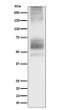


Anti-Somatostatin Receptor 1 antibody [R95-4Q-5] (STJA0035580)
SPECIFICATIONS
ClonalityMonoclonal
HostRabbit
ConjugationUnconjugated
IsotypeIgG
ImmunogenA synthesized peptide derived from human Somatostatin Receptor 1
General Information
| Short Description | Rabbit monoclonal anti-Somatostatin Receptor 1 for use in WB, ICC and IF in Human samples. Datasheet included with dilution recommendations, and related reagents. |
| Applications | WB/ICC/IF |
| Host | Rabbit |
| Reactivity | Human |
| Note | STRICTLY FOR FURTHER SCIENTIFIC RESEARCH USE ONLY (RUO). MUST NOT TO BE USED IN DIAGNOSTIC OR THERAPEUTIC APPLICATIONS. |
Product Properties
| Clonality | Monoclonal |
| Clone ID | R95-4Q-5 |
| Isotype | IgG |
| Conjugation | Unconjugated |
| Purification | Affinity Chromatography |
| Dilution Range | WB 1:500-1:1000IF 1:50-1:200 |
| Formulation | Liquid in PBS, pH 7.4, 150mM NaCl, 0.02% sodium azide and 50% glycerol. |
| Storage Instruction | Store at 4°C short term. Aliquot and store at-20°C long term. Avoid freeze/thaw cycles. |
Target Information
| Gene Symbol | SSTR1 |
| Gene ID | 6751 |
| Uniprot ID | SSR1_HUMAN |
| Immunogen | A synthesized peptide derived from human Somatostatin Receptor 1 |
Additional Info
| Tissue Specificity | Fetal kidney, fetal liver, and adult pancreas, brain, lung, jejunum and stomach. |
| Function | Receptor for somatostatin with higher affinity for somatostatin-14 than -28. This receptor is coupled via pertussis toxin sensitive G proteins to inhibition of adenylyl cyclase. In addition it stimulates phosphotyrosine phosphatase and Na(+)/H(+) exchanger via pertussis toxin insensitive G proteins. |
| Protein Name | Somatostatin Receptor Type 1Ss-1-RSs1-RSs1rSst1Srif-2 |
| Database Links | Reactome: R-HSA-375276Reactome: R-HSA-418594 |
| Cellular Localisation | Cell MembraneMulti-Pass Membrane Protein |
| Alternative Antibody Names | Anti-Somatostatin Receptor Type 1 antibodyAnti-Ss-1-R antibodyAnti-Ss1-R antibodyAnti-Ss1r antibodyAnti-Sst1 antibodyAnti-Srif-2 antibodyAnti-SSTR1 antibody |
Information sourced from Uniprot.org