
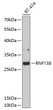


Anti-RNF138 antibody (60-245) (STJ112342)
SPECIFICATIONS
ClonalityPolyclonal
HostRabbit
ConjugationUnconjugated
IsotypeIgG
General Information
| Short Description | Rabbit polyclonal RNF138 (60-245) antibody for use in WB and ELISA in human samples. Datasheet included with dilution recommendations, and related reagents. |
| Applications | WB/ELISA |
| Host | Rabbit |
| Reactivity | Human |
| Note | STRICTLY FOR FURTHER SCIENTIFIC RESEARCH USE ONLY (RUO). MUST NOT TO BE USED IN DIAGNOSTIC OR THERAPEUTIC APPLICATIONS. |
Product Properties
| Clonality | Polyclonal |
| Isotype | IgG |
| Conjugation | Unconjugated |
| Concentration | Lot specific |
| Purification | Affinity purification |
| Dilution Range | WB:1:500-1:2000ELISA:Recommended starting concentration is 1 Mu g/mL. Please optimize the concentration based on your specific assay requirements. |
| Formulation | PBS with 0.02% Sodium Azide, 50% Glycerol, pH 7.3. |
| Storage Instruction | Store at-20°C for up to 1 year from the date of receipt, and avoid repeat freeze-thaw cycles. |
Target Information
| Gene Symbol | Rnf138 |
| Gene ID | 56515 |
| Uniprot ID | RN138_MOUSE |
| Immunogen Region | 60-245 |
| Immunogen Sequence | SVTRRERACPERALDLENIM RRFSGSCRCCSKKIKFYRMR HHYKSCKKYQDEYGVSSVIP NFKISQDSVRSSNRSETSAS DNTETYQEDTSSSGHPTFKC PLCQESNFTRQRLLDHCNSN HLFQIVPVTCPICVSLPWGD PSQITRNFVSHLNQRHQFDY GEFVNLQLDEETQYQTAVEE SFQVNM |
| Specificity | Recombinant fusion protein containing a sequence corresponding to amino acids 60-245 of mouse RNF138 (Q9CQE0). |
Additional Info
| Post Translational Modifications | Auto-ubiquitinated. |
| Function | E3 ubiquitin-protein ligase involved in DNA damage response by promoting DNA resection and homologous recombination. Recruited to sites of double-strand breaks following DNA damage and specifically promotes double-strand break repair via homologous recombination. Two different, non-exclusive, mechanisms have been proposed. According to a report, regulates the choice of double-strand break repair by favoring homologous recombination over non-homologous end joining (NHEJ): acts by mediating ubiquitination of XRCC5/Ku80, leading to remove the Ku complex from DNA breaks, thereby promoting homologous recombination. According to another report, cooperates with UBE2Ds E2 ubiquitin ligases (UBE2D1, UBE2D2, UBE2D3 or UBE2D4) to promote homologous recombination by mediating ubiquitination of RBBP8/CtIP. Together with NLK, involved in the ubiquitination and degradation of TCF/LEF. Also exhibits auto-ubiquitination activity in combination with UBE2K. May act as a negative regulator in the Wnt/beta-catenin-mediated signaling pathway. |
| Protein Name | E3 Ubiquitin-Protein Ligase Rnf138Ring Finger Protein 138Ring-Type E3 Ubiquitin Transferase Rnf138 |
| Database Links | Reactome: R-MMU-983168 |
| Cellular Localisation | ChromosomeRecruited At Dna Damage SitesLocalizes To Sites Of Double-Strand Break: Localization To Double-Strand Break Sites Is Mediated By The Zinc Fingers |
| Alternative Antibody Names | Anti-E3 Ubiquitin-Protein Ligase Rnf138 antibodyAnti-Ring Finger Protein 138 antibodyAnti-Ring-Type E3 Ubiquitin Transferase Rnf138 antibodyAnti-Rnf138 antibodyAnti-Trif antibody |
Information sourced from Uniprot.org