




Anti-RFP antibody (STJ140002)
SPECIFICATIONS
ClonalityPolyclonal
HostGoat
ConjugationUnconjugated
IsotypeIgG
ImmunogenPurified recombinant peptide produced in E. coli.
General Information
| Short Description | Goat polyclonal Red Fluorescent Protein antibody for use in WB, IF, IHC-P, IHC-F and IEM in tdtomato, mcherry and rfp samples. Datasheet included with dilution recommendations, and related reagents. |
| Applications | WB/IF/IHC-P/IHC-F/IEM |
| Host | Goat |
| Reactivity | tdTomato/mCherry/RFP |
| Note | STRICTLY FOR FURTHER SCIENTIFIC RESEARCH USE ONLY (RUO). MUST NOT TO BE USED IN DIAGNOSTIC OR THERAPEUTIC APPLICATIONS. |
Product Properties
| Clonality | Polyclonal |
| Isotype | IgG |
| Conjugation | Unconjugated |
| Concentration | 3 mg/mL |
| Purification | This antibody is epitope-affinity purified from goat antiserum. |
| Dilution Range | WB 1:500-1:2000IHC-F 1:50-1:500IHC-P 1:50-1:500IF 1:50-1:500ELISA NDLorincz R Alvarez AB Walkey CJ et al. Biomed Pharmacother 2022 Dec PMID: 36587560Hirschberg S Dvorzhak A Rasooli-Nejad S et al. bioRxiv 2020Pan H F |
| Formulation | PBS, 20% Glycerol and 0.05% Sodium Azide. |
| Storage Instruction | For continuous use, store at 2-8 C for one-two days. For extended storage, store in-20 C freezer. Working dilution samples should be discarded if not used within 12 hours. |
Target Information
| Immunogen | Purified recombinant peptide produced in E. coli. |
| Immunogen Sequence | MVSKGEEDNMAIIKEFMRFK VSKGEEDNMAIIKEFMRFKV SKGEEDNMAIIKEFMRFKVH KGEEDNMAIIKEFMRFKVHM GEEDNMAIIKEFMRFKVHME EEDNMAIIKEFMRFKVHMEG EDNMAIIKEFMRFKVHMEGS DNMAIIKEFMRFKVHMEGSV NMAIIKEFMRFKVHMEGSVN MAIIKEFMRFKVHMEGSVNG AIIKEFMRFKVHMEGSVNGH IIKEFMRFKVHMEGSVNGH |
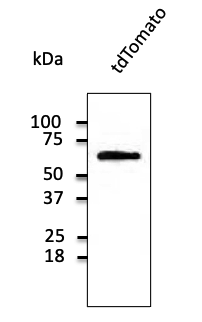
| Specificity | In 293HEK cells transfected with cds plasmid detects a band of 55 kDa by Western blot. It also detects tdTomato in brain sections by IHC. This antibody is specific for tdTomato and mCherry proteins. It does not cross-react to GFP (green fluorescent p |
Additional Info
| Background | Goat polyclonal antibody to tdTomato (red fluorescent protein). tdTomato protein is derived from DsRed, an engineered red fluorescent protein from so-called disc corals of the genus Discosoma. It is a genetic fusion of two copies of the dTomato gene, which has been specifically designed for low aggregation. Its brightness and emission wavelength makes it ideal for live animal research. |
Information sourced from Uniprot.org