

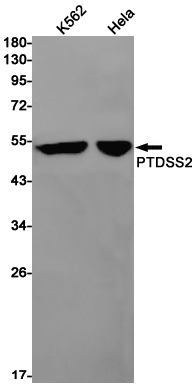

Anti-PSS2 antibody [R07-9G9] (STJA0034770)
SPECIFICATIONS
ClonalityMonoclonal
HostRabbit
ConjugationUnconjugated
IsotypeIgG
ImmunogenRecombinant protein of human PTDSS2
General Information
| Short Description | Rabbit monoclonal anti-PSS2 for use in WB and IP in Human samples. Datasheet included with dilution recommendations, and related reagents. |
| Applications | WB/IP |
| Host | Rabbit |
| Reactivity | Human |
| Note | STRICTLY FOR FURTHER SCIENTIFIC RESEARCH USE ONLY (RUO). MUST NOT TO BE USED IN DIAGNOSTIC OR THERAPEUTIC APPLICATIONS. |
Product Properties
| Clonality | Monoclonal |
| Clone ID | R07-9G9 |
| Isotype | IgG |
| Conjugation | Unconjugated |
| Concentration | 0.3 mg/mL |
| Purification | Affinity Purified |
| Dilution Range | WB 1:500-1:1000IP 1:20 |
| Formulation | 50mM Tris-Glycine (pH 7.4) , 0.15M NaCl, 40% Glycerol, 0.01% Sodium azide and 0.05% BSA |
| Storage Instruction | Store at 4°C short term. Aliquot and store at-20°C long term. Avoid freeze/thaw cycles. |
Target Information
| Gene Symbol | PTDSS2 |
| Gene ID | 81490 |
| Uniprot ID | PTSS2_HUMAN |
| Immunogen | Recombinant protein of human PTDSS2 |
Additional Info
| Function | Catalyzes a base-exchange reaction in which the polar head group of phosphatidylethanolamine (PE) or phosphatidylcholine (PC) is replaced by L-serine. Catalyzes the conversion of phosphatatidylethanolamine and does not act on phosphatidylcholine. Can utilize both phosphatidylethanolamine (PE) plasmalogen and diacyl PE as substrate and the latter is six times better utilized, indicating the importance of an ester linkage at the sn-1 position. Although it shows no sn-1 fatty acyl preference, exhibits significant preference towards docosahexaenoic acid (22:6n-3) compared with 18:1 or 20:4 at the sn-2 position. |
| Protein Name | Phosphatidylserine Synthase 2Pss-2Ptdser Synthase 2Serine-Exchange Enzyme Ii |
| Database Links | Reactome: R-HSA-1483101 |
| Cellular Localisation | Endoplasmic Reticulum MembraneMulti-Pass Membrane ProteinHighly Enriched In The Mitochondria-Associated Membrane (Mam) |
| Alternative Antibody Names | Anti-Phosphatidylserine Synthase 2 antibodyAnti-Pss-2 antibodyAnti-Ptdser Synthase 2 antibodyAnti-Serine-Exchange Enzyme Ii antibodyAnti-PTDSS2 antibodyAnti-PSS2 antibody |
Information sourced from Uniprot.org