
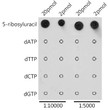


Anti-Pseudouridine/5-ribosyluracil antibody (STJ11103907)
SPECIFICATIONS
ClonalityPolyclonal
HostRabbit
ConjugationUnconjugated
IsotypeIgG
General Information
| Short Description | Rabbit polyclonal Pseudouridine/5-ribosyluracil antibody for use in DB and ELISA in species independent samples. Datasheet included with dilution recommendations, and related reagents. |
| Applications | DB/ELISA |
| Host | Rabbit |
| Reactivity | Species Independent |
| Note | STRICTLY FOR FURTHER SCIENTIFIC RESEARCH USE ONLY (RUO). MUST NOT TO BE USED IN DIAGNOSTIC OR THERAPEUTIC APPLICATIONS. |
Product Properties
| Clonality | Polyclonal |
| Isotype | IgG |
| Conjugation | Unconjugated |
| Concentration | Lot specific |
| Purification | Affinity purification |
| Dilution Range | DB:1:3000-1:10000ELISA:Recommended starting concentration is 1 Mu g/mL. Please optimize the concentration based on your specific assay requirements. |
| Formulation | PBS with 0.01% Thimerosal, 50% Glycerol, pH 7.3. |
| Storage Instruction | Store at-20°C for up to 1 year from the date of receipt, and avoid repeat freeze-thaw cycles. |
Target Information
| Specificity | Chemical compounds corresponding to Pseudouridine/5-ribosyluracil/Y. |
Additional Info
| Background | Pseudouridine is the most abundant post-transcriptional RNA modification, which presents mostly in non-coding RNAs such as tRNA, rRNA, snRNA and snoRNA. Pseudouridine impacts various aspects of RNA biology, conferring distinct structural and functional properties to the RNA molecules that it decorates.? It is also reported that pseudouridine has been found in mRNA in both yeast and human by sequencing analysis. Replacing uridine to pseudouridine enhances structural stability of RNA, and is expected to affect rRNA processing, translation and pre-mRNA splicing. Also, aberrant pseudouridylation contributes to a variety of human diseases, including cancer and genetic disorders. Dysregulation of the pseudouridine epitranscriptome can arise from mutations and abnormal expression of pseudouridylation machinery, impacting protein translation and other cellular processes. |
Information sourced from Uniprot.org