
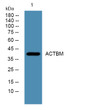


Anti-POTEKP antibody (STJ192013)
SPECIFICATIONS
ClonalityPolyclonal
HostRabbit
ConjugationUnconjugated
IsotypeIgG
ImmunogenSynthesized peptide derived from part of the human protein
General Information
| Short Description | Rabbit polyclonal anti-Putative beta-actin-like protein 3 for use in WB and ELISA in Human, Rat and Mouse samples. Datasheet included with dilution recommendations, and related reagents. |
| Applications | WB/ELISA |
| Host | Rabbit |
| Reactivity | Human/Rat/Mouse |
| Note | STRICTLY FOR FURTHER SCIENTIFIC RESEARCH USE ONLY (RUO). MUST NOT TO BE USED IN DIAGNOSTIC OR THERAPEUTIC APPLICATIONS. |
Product Properties
| Clonality | Polyclonal |
| Isotype | IgG |
| Conjugation | Unconjugated |
| Concentration | 1 mg/mL |
| Purification | The antibody was affinity-purified from rabbit antiserum by affinity-chromatography using epitope-specific immunogen. |
| Dilution Range | WB 1:500-2000ELISA 1:5000-20000 |
| Formulation | Liquid in PBS containing 50% Glycerol and 0.02% Sodium Azide. |
| Storage Instruction | Store at-20°C for up to 1 year from the date of receipt, and avoid repeat freeze-thaw cycles. |
Target Information
| Gene Symbol | POTEKPUniprot ID=ACTBM_HUMAN" |
| Immunogen | Synthesized peptide derived from part of the human protein |
| Specificity | ACTBM Polyclonal Antibody detects endogenous levels of protein. |
Additional Info
| Post Translational Modifications | Oxidation of Met-44 and Met-47 by MICALs (MICAL1, MICAL2 or MICAL3) to form methionine sulfoxide promotes actin filament depolymerization. MICAL1 and MICAL2 produce the (R)-S-oxide form. The (R)-S-oxide form is reverted by MSRB1 and MSRB2, which promote actin repolymerization. Monomethylation at Lys-84 (K84me1) regulates actin-myosin interaction and actomyosin-dependent processes. Demethylation by ALKBH4 is required for maintaining actomyosin dynamics supporting normal cleavage furrow ingression during cytokinesis and cell migration. |
| Protein Name | Putative Beta-Actin-Like Protein 3Kappa-ActinPote Ankyrin Domain Family Member K |
| Cellular Localisation | CytoplasmCytoskeleton |
| Alternative Antibody Names | Anti-Putative Beta-Actin-Like Protein 3 antibodyAnti-Kappa-Actin antibodyAnti-Pote Ankyrin Domain Family Member K antibodyAnti-POTEKP antibodyAnti-ACTBL3 antibodyAnti-FKSG30 antibody |
Information sourced from Uniprot.org