
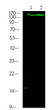


Anti-Phospho-ROCK2-Tyr722 antibody (STJA0009928)
SPECIFICATIONS
ClonalityPolyclonal
HostRabbit
ConjugationUnconjugated
IsotypeIgG
ImmunogenSynthesized peptide derived from human ROCK2 (Phospho-Tyr722)
General Information
| Short Description | Rabbit polyclonal anti-Phospho-Rho-associated protein kinase 2-Tyr722 for use in WB in Human, Mouse and Rat samples. Datasheet included with dilution recommendations, and related reagents. |
| Applications | WB |
| Host | Rabbit |
| Reactivity | Human/Mouse/Rat |
| Note | STRICTLY FOR FURTHER SCIENTIFIC RESEARCH USE ONLY (RUO). MUST NOT TO BE USED IN DIAGNOSTIC OR THERAPEUTIC APPLICATIONS. |
Product Properties
| Clonality | Polyclonal |
| Isotype | IgG |
| Conjugation | Unconjugated |
| Concentration | 1 mg/mL |
| Purification | The antibody was affinity-purified from rabbit serum by affinity-chromatography using specific immunogen. |
| Dilution Range | WB 1:500-2000 |
| Formulation | Liquid in PBS containing 50% Glycerol, 0.5% BSA and 0.02% Sodium Azide. |
| Storage Instruction | Store at-20°C for up to 1 year from the date of receipt, and avoid repeat freeze-thaw cycles. |
Target Information
| Gene Symbol | ROCK2 |
| Gene ID | 9475 |
| Uniprot ID | ROCK2_HUMAN |
| Immunogen | Synthesized peptide derived from human ROCK2 (Phospho-Tyr722) |
| Specificity | This antibody detects endogenous levels of ROCK2 (Phospho-Tyr722) at Human, Mouse, Rat |
Additional Info
| Tissue Specificity | Expressed in the brain (at protein level). |
| Post Translational Modifications | Phosphorylation at Tyr-722 reduces its binding to RHOA and is crucial for focal adhesion dynamics. Dephosphorylation by PTPN11 stimulates its RHOA binding activity. Cleaved by granzyme B during apoptosis. This leads to constitutive activation of the kinase and membrane blebbing. |
| Function | Protein kinase which is a key regulator of actin cytoskeleton and cell polarity. Involved in regulation of smooth muscle contraction, actin cytoskeleton organization, stress fiber and focal adhesion formation, neurite retraction, cell adhesion and motility via phosphorylation of ADD1, BRCA2, CNN1, EZR, DPYSL2, EP300, MSN, MYL9/MLC2, NPM1, RDX, PPP1R12A and VIM. Phosphorylates SORL1 and IRF4. Acts as a negative regulator of VEGF-induced angiogenic endothelial cell activation. Positively regulates the activation of p42/MAPK1-p44/MAPK3 and of p90RSK/RPS6KA1 during myogenic differentiation. Plays an important role in the timely initiation of centrosome duplication. Inhibits keratinocyte terminal differentiation. May regulate closure of the eyelids and ventral body wall through organization of actomyosin bundles. Plays a critical role in the regulation of spine and synaptic properties in the hippocampus. Plays an important role in generating the circadian rhythm of the aortic myofilament Ca(2+) sensitivity and vascular contractility by modulating the myosin light chain phosphorylation. |
| Protein Name | Rho-Associated Protein Kinase 2Rho Kinase 2Rho-Associated - Coiled-Coil-Containing Protein Kinase 2Rho-Associated - Coiled-Coil-Containing Protein Kinase IiRock-IiP164 Rock-2 |
| Database Links | Reactome: R-HSA-3928662Reactome: R-HSA-3928663Reactome: R-HSA-416482Reactome: R-HSA-416572Reactome: R-HSA-4420097Reactome: R-HSA-5627117Reactome: R-HSA-8980692Reactome: R-HSA-9013026Reactome: R-HSA-9013106Reactome: R-HSA-9013407Reactome: R-HSA-9013422Reactome: R-HSA-9679191 |
| Cellular Localisation | CytoplasmCell MembranePeripheral Membrane ProteinNucleusCytoskeletonMicrotubule Organizing CenterCentrosomeCytoplasmicAnd Associated With Actin Microfilaments And The Plasma Membrane |
| Alternative Antibody Names | Anti-Rho-Associated Protein Kinase 2 antibodyAnti-Rho Kinase 2 antibodyAnti-Rho-Associated - Coiled-Coil-Containing Protein Kinase 2 antibodyAnti-Rho-Associated - Coiled-Coil-Containing Protein Kinase Ii antibodyAnti-Rock-Ii antibodyAnti-P164 Rock-2 antibodyAnti-ROCK2 antibodyAnti-KIAA0619 antibody |
Information sourced from Uniprot.org