


Anti-Phospho-CRMP2-Thr-555 antibody [M539] (STJA0041132)
SPECIFICATIONS
ClonalityMonoclonal
HostMouse
ConjugationUnconjugated
IsotypeIgG1
ImmunogenClone M539 was generated from a phospho-CRMP2 (Thr-555) synthetic peptide (coupled to carrier protein) corresponding to amino acids surrounding Thr-555 in human CRMP2. This sequence is conserved in rat and mouse CRMP2 and the phospho-site is not cons
General Information
| Short Description | Mouse monoclonal anti-Phospho-CRMP2-Thr-555 for use in ELISA and WB in Human, Mouse and Rat samples. Datasheet included with dilution recommendations, and related reagents. |
| Applications | ELISA/WB |
| Host | Mouse |
| Reactivity | Human/Mouse/Rat |
| Note | STRICTLY FOR FURTHER SCIENTIFIC RESEARCH USE ONLY (RUO). MUST NOT TO BE USED IN DIAGNOSTIC OR THERAPEUTIC APPLICATIONS. |
Product Properties
| Clonality | Monoclonal |
| Clone ID | M539 |
| Isotype | IgG1 |
| Conjugation | Unconjugated |
| Purification | Antigen Affinity Purified |
| Dilution Range | WB 1:500 |
| Formulation | PBS + 1 mg/ml BSA, 0.05% NaN3 and 50% glycerol |
| Storage Instruction | Storage at-20°C is recommended, as aliquots may be taken without freeze/thawing due to presence of 50% glycerol. Stable for at least 1 year at-20°C. |
Target Information
| Gene Symbol | DPYSL2 |
| Gene ID | 1808 |
| Uniprot ID | DPYL2_HUMAN |
| Immunogen | Clone M539 was generated from a phospho-CRMP2 (Thr-555) synthetic peptide (coupled to carrier protein) corresponding to amino acids surrounding Thr-555 in human CRMP2. This sequence is conserved in rat and mouse CRMP2 and the phospho-site is not cons |
| Immunogen Sequence | Human |
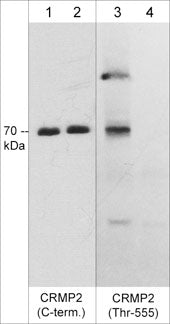
| Specificity | The antibody detects a 70 kDa* protein corresponding to CRMP2 on immunoblots of rat PC12 or mouse C2C12 cells treated with calyculin A. This reactivity is not observed after lambda phosphatase dephosphorylation of Thr-555. |
Additional Info
| Tissue Specificity | Ubiquitous. |
| Post Translational Modifications | 3F4, a monoclonal antibody which strongly stains neurofibrillary tangles in Alzheimer disease brains, specifically labels DPYSL2 when phosphorylated on Ser-518, Ser-522 and Thr-509. Phosphorylation at Thr-514 by GSK3B abolishes tubulin-binding leading to destabilization of microtubule assembly in axons and neurodegeneration. Phosphorylation by DYRK2 at Ser-522 is required for subsequent phosphorylation by GSK3B. |
| Function | Plays a role in neuronal development and polarity, as well as in axon growth and guidance, neuronal growth cone collapse and cell migration. Necessary for signaling by class 3 semaphorins and subsequent remodeling of the cytoskeleton. May play a role in endocytosis. |
| Protein Name | Dihydropyrimidinase-Related Protein 2Drp-2Collapsin Response Mediator Protein 2Crmp-2N2a3Unc-33-Like Phosphoprotein 2Ulip-2 |
| Database Links | Reactome: R-HSA-399956Reactome: R-HSA-437239 |
| Cellular Localisation | CytoplasmCytosolCytoskeletonMembraneTightly But Non-Covalently Associated With Membranes |
| Alternative Antibody Names | Anti-Dihydropyrimidinase-Related Protein 2 antibodyAnti-Drp-2 antibodyAnti-Collapsin Response Mediator Protein 2 antibodyAnti-Crmp-2 antibodyAnti-N2a3 antibodyAnti-Unc-33-Like Phosphoprotein 2 antibodyAnti-Ulip-2 antibodyAnti-DPYSL2 antibodyAnti-CRMP2 antibodyAnti-ULIP2 antibody |
Information sourced from Uniprot.org