

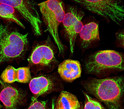


Anti-Nuclear pore Complex antibody [39C7] (STJA0003727)
SPECIFICATIONS
ClonalityMonoclonal
HostMouse
ConjugationUnconjugated
IsotypeIgG1
ImmunogenYeast nuclear preparations.
General Information
| Short Description | Mouse monoclonal antibody anti-Nuclear pore Complex is suitable for use in Immunocytochemistry research applications. |
| Applications | ICC |
| Host | Mouse |
| Reactivity | Bovine/Chicken/D.melanogaster/Human/Mouse/Rat |
| Note | STRICTLY FOR FURTHER SCIENTIFIC RESEARCH USE ONLY (RUO). MUST NOT TO BE USED IN DIAGNOSTIC OR THERAPEUTIC APPLICATIONS. |
Product Properties
| Clonality | Monoclonal |
| Clone ID | 39C7 |
| Isotype | IgG1 |
| Conjugation | Unconjugated |
| Purification | This antibody was concentrated tissue culture from supernatant. |
| Dilution Range | ICC 1:50-1:100 (mammalian cells) 1:100-1:500 (yeast cells) |
| Formulation | 100 ul in PBS + 10 mM Sodium Azide. |
| Storage Instruction | Store at-20°C for up to 1 year from the date of receipt, and avoid repeat freeze-thaw cycles. |
Target Information
| Immunogen | Yeast nuclear preparations. |
Additional Info
| Background | The nuclear pore complex (NPC) is a very large structure made up of at least 50 different proteins that span the double membrane of the nuclear envelope functioning as a gateway for macromolecular traffic between the cytoplasm and the nucleus (Nakielny and Dreyfuss, 1999). Discrete nuclear pore complex proteins or nucleoporins such as NUP98, NUP180 and p62 have been implicated in autoimmune disease and cancer. Patients with primary biliary cirrhosis (PBC) frequently produce autoantibodies against p62 and NUP180 (Wilken et al., 1993; Nesher et al., 2001) while NUP98 translocations have been found in patients with acute myelogenous leukemia (AML) (Jaju et al. 2001). |
Information sourced from Uniprot.org