

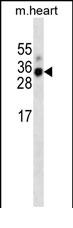

Anti-Myogenin antibody [304CT11.6.1] (STJA0033003)
SPECIFICATIONS
ClonalityMonoclonal
HostMouse
ConjugationUnconjugated
IsotypeIgG1
ImmunogenThis MYOG antibody is generated from mice immunized with a KLH conjugated synthetic peptide from the N-terminal region of human MYOG.
General Information
| Short Description | Mouse monoclonal anti-Myogenin for use in WB in Mouse samples. Datasheet included with dilution recommendations, and related reagents. |
| Applications | WB |
| Host | Mouse |
| Reactivity | Mouse |
| Note | STRICTLY FOR FURTHER SCIENTIFIC RESEARCH USE ONLY (RUO). MUST NOT TO BE USED IN DIAGNOSTIC OR THERAPEUTIC APPLICATIONS. |
Product Properties
| Clonality | Monoclonal |
| Clone ID | 304CT11.6.1 |
| Isotype | IgG1 |
| Conjugation | Unconjugated |
| Purification | Affinity Purified |
| Dilution Range | WB 1:500-1:1000 |
| Formulation | Liquid in PBS containing 0.09% sodium azide, pH 7.3. |
| Storage Instruction | Store at 4°C short term. Aliquot and store at-20°C long term. Avoid freeze/thaw cycles. |
Target Information
| Gene Symbol | MYOG |
| Gene ID | 4656 |
| Uniprot ID | MYOG_HUMAN |
| Immunogen | This MYOG antibody is generated from mice immunized with a KLH conjugated synthetic peptide from the N-terminal region of human MYOG. |
Additional Info
| Post Translational Modifications | Phosphorylated by CAMK2G on threonine and serine amino acids in a muscle activity-dependent manner. Phosphorylation of Thr-87 impairs both DNA-binding and trans-activation functions in contracting muscles. |
| Function | Acts as a transcriptional activator that promotes transcription of muscle-specific target genes and plays a role in muscle differentiation, cell cycle exit and muscle atrophy. Essential for the development of functional embryonic skeletal fiber muscle differentiation. However is dispensable for postnatal skeletal muscle growth.phosphorylation by CAMK2G inhibits its transcriptional activity in respons to muscle activity. Required for the recruitment of the FACT complex to muscle-specific promoter regions, thus promoting gene expression initiation. During terminal myoblast differentiation, plays a role as a strong activator of transcription at loci with an open chromatin structure previously initiated by MYOD1. Together with MYF5 and MYOD1, co-occupies muscle-specific gene promoter core regions during myogenesis. Also cooperates with myocyte-specific enhancer factor MEF2D and BRG1-dependent recruitment of SWI/SNF chromatin-remodeling enzymes to alter chromatin structure at myogenic late gene promoters. Facilitates cell cycle exit during terminal muscle differentiation through the up-regulation of miR-20a expression, which in turn represses genes involved in cell cycle progression. Binds to the E-box containing (E1) promoter region of the miR-20a gene. Also plays a role in preventing reversal of muscle cell differentiation. Contributes to the atrophy-related gene expression in adult denervated muscles. Induces fibroblasts to differentiate into myoblasts. |
| Protein Name | MyogeninClass C Basic Helix-Loop-Helix Protein 3Bhlhc3Myogenic Factor 4Myf-4 |
| Database Links | Reactome: R-HSA-525793Reactome: R-HSA-9839394 |
| Cellular Localisation | NucleusRecruited To Late Myogenic Gene Promoter Regulatory Sequences With Smarca4/Brg1/Baf190a And Swi/Snf Chromatin-Remodeling Enzymes To Promote Chromatin-Remodeling And Transcription Initiation In Developing Embryos |
| Alternative Antibody Names | Anti-Myogenin antibodyAnti-Class C Basic Helix-Loop-Helix Protein 3 antibodyAnti-Bhlhc3 antibodyAnti-Myogenic Factor 4 antibodyAnti-Myf-4 antibodyAnti-MYOG antibodyAnti-BHLHC3 antibodyAnti-MYF4 antibody |
Information sourced from Uniprot.org