


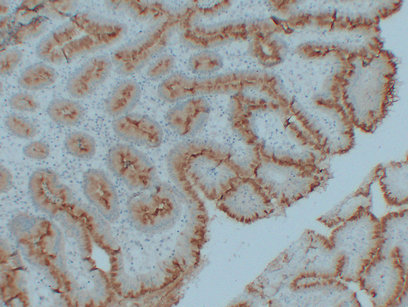
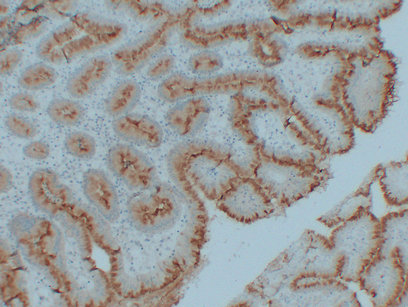

Anti-Mucin 5AC antibody [6E2-5E5-2A6] (STJA0033528)
SPECIFICATIONS
ClonalityMonoclonal
HostMouse
ConjugationUnconjugated
IsotypeIgG
ImmunogenSynthesized peptide derived from human MUC5AC
General Information
| Short Description | Mouse monoclonal anti-Mucin 5AC for use in IHC-P in Human samples. Datasheet included with dilution recommendations, and related reagents. |
| Applications | IHC-P |
| Host | Mouse |
| Reactivity | Human |
| Note | STRICTLY FOR FURTHER SCIENTIFIC RESEARCH USE ONLY (RUO). MUST NOT TO BE USED IN DIAGNOSTIC OR THERAPEUTIC APPLICATIONS. |
Product Properties
| Clonality | Monoclonal |
| Clone ID | 6E2-5E5-2A6 |
| Isotype | IgG |
| Conjugation | Unconjugated |
| Concentration | 1 mg/mL |
| Purification | Affinity Chromatography |
| Dilution Range | IHC 1:100-1:500 |
| Formulation | Liquid in PBS containing 50% glycerol, 0.5% BSA and 0.02% sodium azide, pH 7.3. |
| Storage Instruction | Store at 4°C short term. Aliquot and store at-20°C long term. Avoid freeze/thaw cycles. |
Target Information
| Gene Symbol | MUC5AC |
| Gene ID | 4586 |
| Uniprot ID | MUC5A_HUMAN |
| Immunogen | Synthesized peptide derived from human MUC5AC |
Additional Info
| Tissue Specificity | Highly expressed in surface mucosal cells of respiratory tract and stomach epithelia. Overexpressed in a number of carcinomas. Also expressed in Barrett's esophagus epithelium and in the proximal duodenum. |
| Post Translational Modifications | C-, O- and N-glycosylated. O-glycosylated on the second and last Thr of the Thr-/Ser-rich tandem repeats TTPSPVPTTSTTSA. One form of glycosylation is also known as Lewis B (LeB) blood group antigen, a tetrasaccharide consisting of N-acetylglucosamine having a fucosyl residue attached. It has a role as an epitope and antigen and functions as a receptor for H.pylori binding and facilitates infection. C-mannosylation in the Cys-rich subdomains may be required for proper folding of these regions and for export from the endoplasmic reticulum during biosynthesis. Proteolytic cleavage in the C-terminal is initiated early in the secretory pathway and does not involve a serine protease. The extent of cleavage is increased in the acidic parts of the secretory pathway. Cleavage generates a reactive group which could link the protein to a primary amide. |
| Function | Gel-forming glycoprotein of gastric and respiratory tract epithelia that protects the mucosa from infection and chemical damage by binding to inhaled microorganisms and particles that are subsequently removed by the mucociliary system. Interacts with H.pylori in the gastric epithelium, Barrett's esophagus as well as in gastric metaplasia of the duodenum (GMD). |
| Protein Name | Mucin-5acMuc-5acGastric MucinMajor Airway GlycoproteinMucin-5 Subtype Ac - TracheobronchialTracheobronchial MucinTbm |
| Database Links | Reactome: R-HSA-5083625Reactome: R-HSA-5083632Reactome: R-HSA-5083636Reactome: R-HSA-5621480Reactome: R-HSA-913709Reactome: R-HSA-977068 |
| Cellular Localisation | Secreted |
| Alternative Antibody Names | Anti-Mucin-5ac antibodyAnti-Muc-5ac antibodyAnti-Gastric Mucin antibodyAnti-Major Airway Glycoprotein antibodyAnti-Mucin-5 Subtype Ac - Tracheobronchial antibodyAnti-Tracheobronchial Mucin antibodyAnti-Tbm antibodyAnti-MUC5AC antibodyAnti-MUC5 antibody |
Information sourced from Uniprot.org