
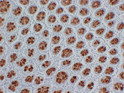

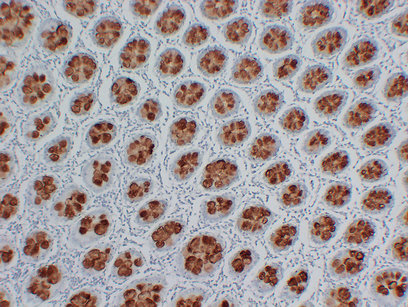
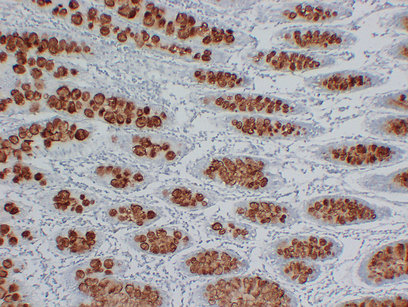

Anti-Mucin 2 antibody [4E9-9B4-9F5] (STJA0033468)
SPECIFICATIONS
ClonalityMonoclonal
HostMouse
ConjugationUnconjugated
IsotypeIgG1
ImmunogenSynthesized peptide derived from human MUC2
General Information
| Short Description | Mouse monoclonal anti-Mucin 2 for use in IHC-P in Human samples. Datasheet included with dilution recommendations, and related reagents. |
| Applications | IHC-P |
| Host | Mouse |
| Reactivity | Human |
| Note | STRICTLY FOR FURTHER SCIENTIFIC RESEARCH USE ONLY (RUO). MUST NOT TO BE USED IN DIAGNOSTIC OR THERAPEUTIC APPLICATIONS. |
Product Properties
| Clonality | Monoclonal |
| Clone ID | 4E9-9B4-9F5 |
| Isotype | IgG1 |
| Conjugation | Unconjugated |
| Concentration | 1 mg/mL |
| Purification | Affinity Chromatography |
| Dilution Range | IHC 1:100-1:500 |
| Formulation | Liquid in PBS containing 50% glycerol, 0.5% BSA and 0.02% sodium azide, pH 7.3. |
| Storage Instruction | Store at 4°C short term. Aliquot and store at-20°C long term. Avoid freeze/thaw cycles. |
Target Information
| Gene Symbol | MUC2 |
| Gene ID | 4583 |
| Uniprot ID | MUC2_HUMAN |
| Immunogen | Synthesized peptide derived from human MUC2 |
Additional Info
| Tissue Specificity | Colon, small intestine, colonic tumors, bronchus, cervix and gall bladder. |
| Post Translational Modifications | O-glycosylated. O-glycosylation is required for mucin assembly. Goblet cells synthesize two forms of mucin that differ in branched chain O-glycosylation and the site of production in the colon. May undergo proteolytic cleavage in the outer mucus layer of the colon, contributing to the expanded volume and loose nature of this layer which allows for bacterial colonization in contrast to the inner mucus layer which is dense and devoid of bacteria. At low pH of 6 and under, undergoes autocatalytic cleavage in vitro in the N-terminal region of the fourth VWD domain. It is likely that this also occurs in vivo and is triggered by the low pH of the late secretory pathway. |
| Function | Coats the epithelia of the intestines and other mucus membrane-containing organs to provide a protective, lubricating barrier against particles and infectious agents at mucosal surfaces. Major constituent of the colon mucus, which is mainly formed by large polymeric networks of MUC2 secreted by goblet cells that cover the exposed surfaces of intestine. MUC2 networks form hydrogels that guard the underlying epithelium from pathogens and other hazardous matter entering from the outside world, while permitting nutrient absorption and gas exchange. Acts as a divalent copper chaperone that protects intestinal cells from copper toxicity and facilitates nutritional copper unptake into cells. Binds both Cu(2+) and its reduced form, Cu(1+), at two juxtaposed binding sites: Cu(2+), once reduced to Cu(1+) by vitamin C (ascorbate) or other dietary antioxidants, transits to the other binding site. MUC2-bound Cu(1+) is protected from oxidation in aerobic environments, and can be released for nutritional delivery to cells. Mucin gels store antimicrobial molecules that participate in innate immunity. Mucin glycoproteins also house and feed the microbiome, lubricate tissue surfaces, and may facilitate the removal of contaminants and waste products from the body. Goblet cells synthesize two forms of MUC2 mucin that differ in branched chain O-glycosylation and the site of production in the colon: a (1) 'thick' mucus that wraps the microbiota to form fecal pellets is produced in the proximal, ascending colon. 'Thick' mucus transits along the descending colon and is lubricated by a (2) 'thin' MUC2 mucus produced in the distal colon which adheres to the 'thick' mucus. |
| Protein Name | Mucin-2Muc-2Intestinal Mucin-2 |
| Database Links | Reactome: R-HSA-5083625Reactome: R-HSA-5083632Reactome: R-HSA-5083636Reactome: R-HSA-5621480Reactome: R-HSA-913709Reactome: R-HSA-977068 |
| Cellular Localisation | SecretedIn The IntestineSecreted Into The Inner And Outer Mucus LayersBefore SecretionMucin Polymers Are Stored In Dedicated Secretory Vesicles |
| Alternative Antibody Names | Anti-Mucin-2 antibodyAnti-Muc-2 antibodyAnti-Intestinal Mucin-2 antibodyAnti-MUC2 antibodyAnti-SMUC antibody |
Information sourced from Uniprot.org