
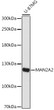


Anti-MAN2A2 antibody (100-200) (STJ11103025)
SPECIFICATIONS
ClonalityPolyclonal
HostRabbit
ConjugationUnconjugated
IsotypeIgG
General Information
| Short Description | Rabbit polyclonal MAN2A2 (100-200) antibody for use in WB and ELISA in human samples. Datasheet included with dilution recommendations, and related reagents. |
| Applications | WB/ELISA |
| Host | Rabbit |
| Reactivity | Human |
| Note | STRICTLY FOR FURTHER SCIENTIFIC RESEARCH USE ONLY (RUO). MUST NOT TO BE USED IN DIAGNOSTIC OR THERAPEUTIC APPLICATIONS. |
Product Properties
| Clonality | Polyclonal |
| Isotype | IgG |
| Conjugation | Unconjugated |
| Concentration | Lot specific |
| Purification | Affinity purification |
| Dilution Range | WB:1:500-1:1000ELISA:Recommended starting concentration is 1 Mu g/mL. Please optimize the concentration based on your specific assay requirements. |
| Formulation | PBS with 0.01% Thimerosal, 50% Glycerol, pH 7.3. |
| Storage Instruction | Store at-20°C for up to 1 year from the date of receipt, and avoid repeat freeze-thaw cycles. |
Target Information
| Gene Symbol | MAN2A2 |
| Gene ID | 4122 |
| Uniprot ID | MA2A2_HUMAN |
| Immunogen Region | 100-200 |
| Immunogen Sequence | VPPEPRPSFFSISPQDCQFA LGGRGQKPELQMLTVSEELP FDNVDGGVWRQGFDISYDPH DWDAEDLQVFVVPHSHNDPG WIKTFDKYYTEQTQHILNSM V |
| Specificity | A synthetic peptide corresponding to a sequence within amino acids 100-200 of human MAN2A2 (NP_006113.2). |
Additional Info
| Function | Catalyzes the first committed step in the biosynthesis of complex N-glycans. It controls conversion of high mannose to complex N-glycans.the final hydrolytic step in the N-glycan maturation pathway. |
| Protein Name | Alpha-Mannosidase 2xAlpha-Mannosidase IixMan IixMannosidase Alpha Class 2a Member 2Mannosyl-Oligosaccharide 1 -3-1 -6-Alpha-Mannosidase |
| Database Links | Reactome: R-HSA-6811438Reactome: R-HSA-975578 |
| Cellular Localisation | Golgi Apparatus MembraneSingle-Pass Type Ii Membrane Protein |
| Alternative Antibody Names | Anti-Alpha-Mannosidase 2x antibodyAnti-Alpha-Mannosidase Iix antibodyAnti-Man Iix antibodyAnti-Mannosidase Alpha Class 2a Member 2 antibodyAnti-Mannosyl-Oligosaccharide 1 -3-1 -6-Alpha-Mannosidase antibodyAnti-MAN2A2 antibodyAnti-MANA2X antibody |
Information sourced from Uniprot.org