


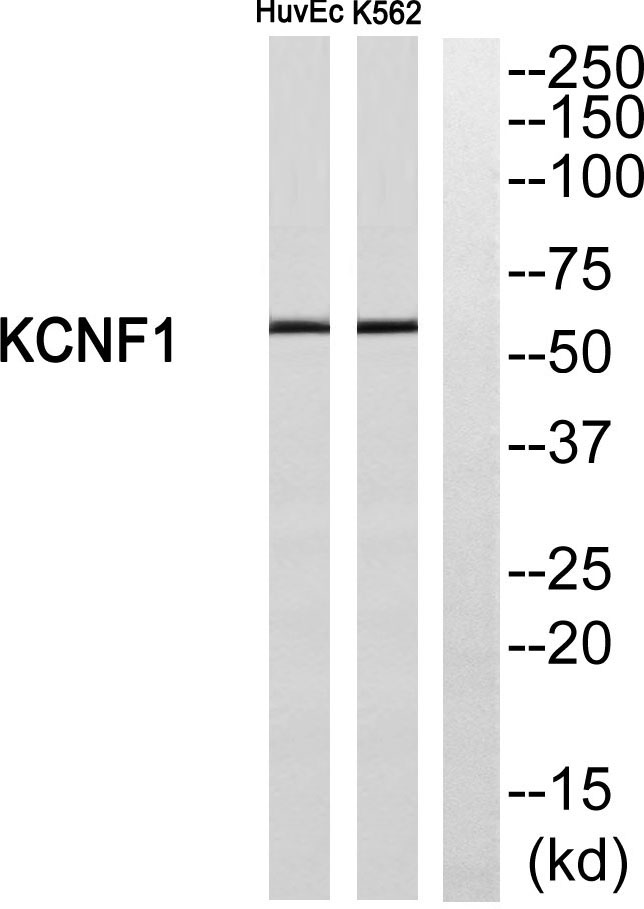
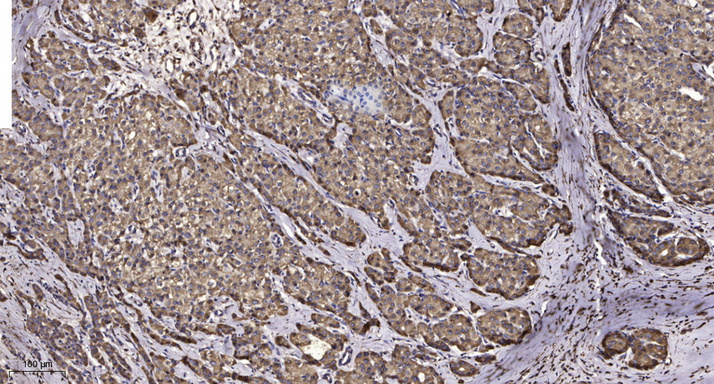

Anti-KCNF1 antibody (191-240 aa) (STJ93818)
SPECIFICATIONS
ClonalityPolyclonal
HostRabbit
ConjugationUnconjugated
IsotypeIgG
ImmunogenThe antiserum was produced against synthesized peptide derived from the human KCNF1 at the amino acid range 191-240
General Information
| Short Description | Rabbit polyclonal anti-Potassium voltage-gated channel subfamily F member 1 (191-240 aa) for use in WB, ELISA and IHC in Human and Mouse samples. Datasheet included with dilution recommendations, and related reagents. |
| Applications | WB/ELISA/IHC |
| Host | Rabbit |
| Reactivity | Human/Mouse |
| Note | STRICTLY FOR FURTHER SCIENTIFIC RESEARCH USE ONLY (RUO). MUST NOT TO BE USED IN DIAGNOSTIC OR THERAPEUTIC APPLICATIONS. |
Product Properties
| Clonality | Polyclonal |
| Isotype | IgG |
| Conjugation | Unconjugated |
| Concentration | 1 mg/mL |
| Purification | The antibody was affinity-purified from rabbit antiserum by affinity-chromatography using epitope-specific immunogen. |
| Dilution Range | WB 1:500-2000IHC-P 1:50-300ELISA 2000-20000 |
| Formulation | Liquid in PBS containing 50% Glycerol, 0.5% BSA and 0.02% Sodium Azide. |
| Storage Instruction | Store at-20°C for up to 1 year from the date of receipt, and avoid repeat freeze-thaw cycles. |
Target Information
| Gene Symbol | KCNF1 |
| Gene ID | 3754 |
| Uniprot ID | KCNF1_HUMAN |
| Immunogen | The antiserum was produced against synthesized peptide derived from the human KCNF1 at the amino acid range 191-240 |
| Immunogen Region | 191-240 aa |
| Specificity | KCNF1 Polyclonal Antibody detects endogenous levels of KCNF1 protein. |
Additional Info
| Function | Regulatory alpha-subunit of the voltage-gated potassium (Kv) channel which, when coassembled with KCNB1 or KCNB2, can modulate their expression and their gating kinetics by acting on deactivation upon repolarization and inactivation during maintained depolarization. Accelerates inactivation but has relatively little effect on deactivation. Coexpression with KCNB1 or KCNB2 markedly slows inactivation. Each modulatory subunit has its own specific properties of regulation, and can lead to extensive inhibitions, to large changes in kinetics, and/or to large shifts in the voltage dependencies of the inactivation process. The gating kinetics depends on the nature and stoichiometry of the associated regulatory sunbunit. Fails to produce a potassium current when expressed alone. |
| Protein Name | Voltage-Gated Potassium Channel Regulatory Subunit Kcnf1Potassium Voltage-Gated Channel Subfamily F Member 1Voltage-Gated Potassium Channel Subunit Kv5.1Kh1 |
| Database Links | Reactome: R-HSA-1296072 |
| Cellular Localisation | Cell MembraneMulti-Pass Membrane Protein |
| Alternative Antibody Names | Anti-Voltage-Gated Potassium Channel Regulatory Subunit Kcnf1 antibodyAnti-Potassium Voltage-Gated Channel Subfamily F Member 1 antibodyAnti-Voltage-Gated Potassium Channel Subunit Kv5.1 antibodyAnti-Kh1 antibodyAnti-KCNF1 antibody |
Information sourced from Uniprot.org