

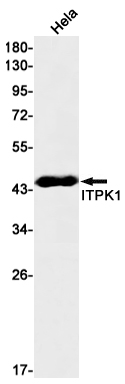

Anti-ITPK1 antibody [R01-7C2] (STJA0034491)
SPECIFICATIONS
ClonalityMonoclonal
HostRabbit
ConjugationUnconjugated
IsotypeIgG
ImmunogenA synthetic peptide of human ITPK1
General Information
| Short Description | Rabbit monoclonal anti-ITPK1 for use in WB and IP in Human samples. Datasheet included with dilution recommendations, and related reagents. |
| Applications | WB/IP |
| Host | Rabbit |
| Reactivity | Human |
| Note | STRICTLY FOR FURTHER SCIENTIFIC RESEARCH USE ONLY (RUO). MUST NOT TO BE USED IN DIAGNOSTIC OR THERAPEUTIC APPLICATIONS. |
Product Properties
| Clonality | Monoclonal |
| Clone ID | R01-7C2 |
| Isotype | IgG |
| Conjugation | Unconjugated |
| Concentration | 0.3 mg/mL |
| Purification | Affinity Purified |
| Dilution Range | WB 1:500-1:1000IP 1:20 |
| Formulation | 50mM Tris-Glycine (pH 7.4) , 0.15M NaCl, 40% Glycerol, 0.01% Sodium azide and 0.05% BSA |
| Storage Instruction | Store at 4°C short term. Aliquot and store at-20°C long term. Avoid freeze/thaw cycles. |
Target Information
| Gene Symbol | ITPK1 |
| Gene ID | 3705 |
| Uniprot ID | ITPK1_HUMAN |
| Immunogen | A synthetic peptide of human ITPK1 |
Additional Info
| Tissue Specificity | Expressed in brain > heart > skeletal muscle = kidney = pancreas = liver = placenta > lung. In brain, it is expressed in cerebellum, cerebral cortex, medulla, spinal cord, occipital lobe, frontal lobe, temporal lobe and putamen. |
| Post Translational Modifications | Acetylation by EP300 and CREBBP destabilizes ITPK1, and down-regulates enzymatic activity. Deacetylated by SIRT1. |
| Function | Kinase that can phosphorylate various inositol polyphosphate such as Ins(3,4,5,6)P4 or Ins(1,3,4)P3. Phosphorylates Ins(3,4,5,6)P4 at position 1 to form Ins(1,3,4,5,6)P5. This reaction is thought to have regulatory importance, since Ins(3,4,5,6)P4 is an inhibitor of plasma membrane Ca(2+)-activated Cl(-) channels, while Ins(1,3,4,5,6)P5 is not. Also phosphorylates Ins(1,3,4)P3 on O-5 and O-6 to form Ins(1,3,4,6)P4, an essential molecule in the hexakisphosphate (InsP6) pathway. Also acts as an inositol polyphosphate phosphatase that dephosphorylates Ins(1,3,4,5)P4 and Ins(1,3,4,6)P4 to Ins(1,3,4)P3, and Ins(1,3,4,5,6)P5 to Ins(3,4,5,6)P4. May also act as an isomerase that interconverts the inositol tetrakisphosphate isomers Ins(1,3,4,5)P4 and Ins(1,3,4,6)P4 in the presence of ADP and magnesium. Probably acts as the rate-limiting enzyme of the InsP6 pathway. Modifies TNF-alpha-induced apoptosis by interfering with the activation of TNFRSF1A-associated death domain. Plays an important role in MLKL-mediated necroptosis. Produces highly phosphorylated inositol phosphates such as inositolhexakisphosphate (InsP6) which bind to MLKL mediating the release of an N-terminal auto-inhibitory region leading to its activation. Essential for activated phospho-MLKL to oligomerize and localize to the cell membrane during necroptosis. |
| Protein Name | Inositol-Tetrakisphosphate 1-KinaseInositol 1 -3 -4-Trisphosphate 5/6-KinaseInositol-Triphosphate 5/6-KinaseIns(1 -3 -4p(3 5/6-Kinase |
| Database Links | Reactome: R-HSA-1855167Reactome: R-HSA-1855204Reactome: R-HSA-983231 |
| Cellular Localisation | |
| Alternative Antibody Names | Anti-Inositol-Tetrakisphosphate 1-Kinase antibodyAnti-Inositol 1 -3 -4-Trisphosphate 5/6-Kinase antibodyAnti-Inositol-Triphosphate 5/6-Kinase antibodyAnti-Ins(1 -3 -4p(3 5/6-Kinase antibodyAnti-ITPK1 antibody |
Information sourced from Uniprot.org