

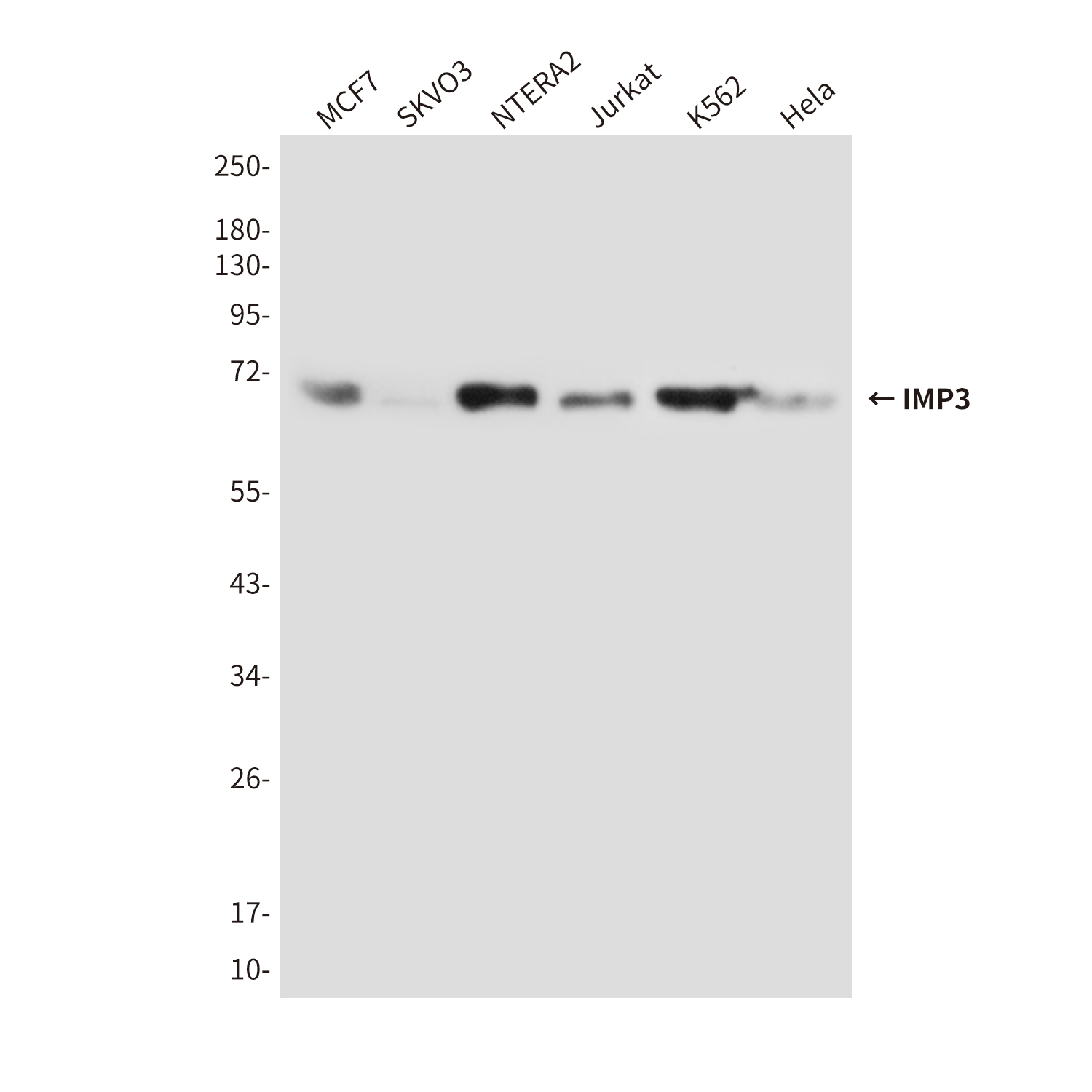

Anti-IMP3 antibody [1F1-E10-D11] (STJA0032436)
SPECIFICATIONS
ClonalityMonoclonal
HostMouse
ConjugationUnconjugated
IsotypeIgG1
ImmunogenPurified recombinant human IMP3 protein fragments expressed in E.coli.
General Information
| Short Description | Mouse monoclonal anti-IMP3 for use in WB in Human samples. Datasheet included with dilution recommendations, and related reagents. |
| Applications | WB |
| Host | Mouse |
| Reactivity | Human |
| Note | STRICTLY FOR FURTHER SCIENTIFIC RESEARCH USE ONLY (RUO). MUST NOT TO BE USED IN DIAGNOSTIC OR THERAPEUTIC APPLICATIONS. |
Product Properties
| Clonality | Monoclonal |
| Clone ID | 1F1-E10-D11 |
| Isotype | IgG1 |
| Conjugation | Unconjugated |
| Concentration | 5.55 mg/mL |
| Purification | Affinity Purified |
| Dilution Range | WB 1:500-1:1000 |
| Formulation | Liquid in PBS containing 50% glycerol, 0.5% BSA and 0.02% sodium azide, pH 7.3. |
| Storage Instruction | Store at 4°C short term. Aliquot and store at-20°C long term. Avoid freeze/thaw cycles. |
Target Information
| Gene Symbol | IGF2BP3 |
| Gene ID | 10643 |
| Uniprot ID | IF2B3_HUMAN |
| Immunogen | Purified recombinant human IMP3 protein fragments expressed in E.coli. |
Additional Info
| Tissue Specificity | Expressed in fetal liver, fetal lung, fetal kidney, fetal thymus, fetal placenta, fetal follicles of ovary and gonocytes of testis, growing oocytes, spermatogonia and semen (at protein level). Expressed in cervix adenocarcinoma, in testicular, pancreatic and renal-cell carcinomas (at protein level). Expressed ubiquitously during fetal development at 8 and 14 weeks of gestation. Expressed in ovary, testis, brain, placenta, pancreatic cancer tissues and pancreatic cancer cell lines. |
| Function | RNA-binding factor that may recruit target transcripts to cytoplasmic protein-RNA complexes (mRNPs). This transcript 'caging' into mRNPs allows mRNA transport and transient storage. It also modulates the rate and location at which target transcripts encounter the translational apparatus and shields them from endonuclease attacks or microRNA-mediated degradation. Preferentially binds to N6-methyladenosine (m6A)-containing mRNAs and increases their stability. Binds to the 3'-UTR of CD44 mRNA and stabilizes it, hence promotes cell adhesion and invadopodia formation in cancer cells. Binds to beta-actin/ACTB and MYC transcripts. Increases MYC mRNA stability by binding to the coding region instability determinant (CRD) and binding is enhanced by m6A-modification of the CRD. Binds to the 5'-UTR of the insulin-like growth factor 2 (IGF2) mRNAs. |
| Protein Name | Insulin-Like Growth Factor 2 Mrna-Binding Protein 3Igf2 Mrna-Binding Protein 3Imp-3Igf-Ii Mrna-Binding Protein 3Kh Domain-Containing Protein Overexpressed In CancerHkocVickz Family Member 3 |
| Database Links | Reactome: R-HSA-428359 |
| Cellular Localisation | NucleusCytoplasmP-BodyStress GranuleFound In Lamellipodia Of The Leading EdgeIn The Perinuclear RegionAnd Beneath The Plasma MembraneThe Subcytoplasmic Localization Is Cell Specific And Regulated By Cell Contact And GrowthLocalized At The Connecting Piece And The Tail Of The SpermatozoaColocalized With Cd44 Mrna In Rnp GranulesIn Response To Cellular StressSuch As Oxidative StressRecruited To Stress Granules |
| Alternative Antibody Names | Anti-Insulin-Like Growth Factor 2 Mrna-Binding Protein 3 antibodyAnti-Igf2 Mrna-Binding Protein 3 antibodyAnti-Imp-3 antibodyAnti-Igf-Ii Mrna-Binding Protein 3 antibodyAnti-Kh Domain-Containing Protein Overexpressed In Cancer antibodyAnti-Hkoc antibodyAnti-Vickz Family Member 3 antibodyAnti-IGF2BP3 antibodyAnti-IMP3 antibodyAnti-KOC1 antibodyAnti-VICKZ3 antibody |
Information sourced from Uniprot.org