
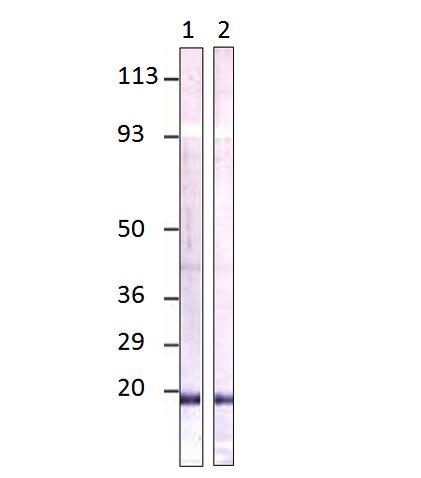

Anti-IL23A antibody (162-179) (STJ501441)
SPECIFICATIONS
ClonalityPolyclonal
HostRabbit
ConjugationUnconjugated
IsotypeIgG
ImmunogenSynthetic peptide corresponding to C terminal region amino acids 162-179 of Human IL23 P19. Peptide was covalently modified.
General Information
| Short Description | Rabbit polyclonal antibody anti-IL23A (162-179) is suitable for use in ELISA and Western Blot research applications. |
| Applications | ELISA/WB |
| Host | Rabbit |
| Reactivity | Human/Mouse/Rat |
| Note | STRICTLY FOR FURTHER SCIENTIFIC RESEARCH USE ONLY (RUO). MUST NOT TO BE USED IN DIAGNOSTIC OR THERAPEUTIC APPLICATIONS. |
Product Properties
| Clonality | Polyclonal |
| Isotype | IgG |
| Conjugation | Unconjugated |
| Concentration | 0.65 µg/µl |
| Purification | Affinity Purified |
| Dilution Range | WB: 1:250DB: 1:10, 000ELISA: 1:10, 000 |
| Formulation | Contains Tris, HCl/Glycine buffer pH 7.4-7.8, 30% Glycerol and 0.5% BSA, along with cryo-protective agents, Hepes, and long-term preservatives (0.02% Sodium Azide). |
| Storage Instruction | Store at-20°C for long term storage. Avoid freeze-thaw cycles. |
Target Information
| Gene Symbol | IL23A |
| Gene ID | 51561 |
| Uniprot ID | IL23A_HUMAN |
| Immunogen | Synthetic peptide corresponding to C terminal region amino acids 162-179 of Human IL23 P19. Peptide was covalently modified. |
| Immunogen Region | 162-179 |
| Specificity | Does not cross react with other Interleukins or other proteins. |
Additional Info
| Tissue Specificity | Secreted by activated dendritic and phagocytic cells and keratinocytes. Also expressed by dermal Langerhans cells (at protein level). |
| Function | Associates with IL12B to form the pro-inflammatory cytokine IL-23 that plays different roles in innate and adaptive immunity. Released by antigen-presenting cells such as dendritic cells or macrophages, binds to a heterodimeric receptor complex composed of IL12RB1 and IL23R to activate JAK2 and TYK2 which then phosphorylate the receptor to form a docking site leading to the phosphorylation of STAT3 and STAT4. This process leads to activation of several pathways including p38 MAPK or NF-kappa-B and promotes the production of pro-inflammatory cytokines such as interleukin-17A/IL17A. In turn, participates in the early and effective intracellular bacterial clearance. Promotes the expansion and survival of T-helper 17 cells, a CD4-positive helper T-cell subset that produces IL-17, as well as other IL-17-producing cells. |
| Protein Name | Interleukin-23 Subunit AlphaIl-23 Subunit AlphaIl-23-AInterleukin-23 Subunit P19Il-23p19 |
| Database Links | Reactome: R-HSA-6785807Reactome: R-HSA-9020933 |
| Cellular Localisation | SecretedSecreted Upon Association With Il12b |
| Alternative Antibody Names | Anti-Interleukin-23 Subunit Alpha antibodyAnti-Il-23 Subunit Alpha antibodyAnti-Il-23-A antibodyAnti-Interleukin-23 Subunit P19 antibodyAnti-Il-23p19 antibodyAnti-IL23A antibodyAnti-SGRF antibodyAnti-UNQ2498 antibodyAnti-PRO5798 antibody |
Information sourced from Uniprot.org