

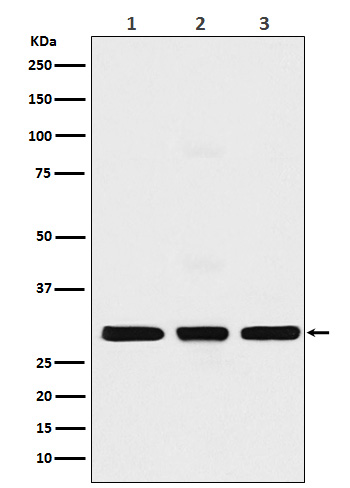

Anti-Histone H1.2 antibody [R06-3D5] (STJA0036698)
SPECIFICATIONS
ClonalityMonoclonal
HostRabbit
ConjugationUnconjugated
IsotypeIgG
ImmunogenA synthesized peptide derived from human Histone H1.2
General Information
| Short Description | Rabbit monoclonal anti-Histone H1.2 for use in WB, IHC-P, ICC, IF and ChIP in Human, Mouse and Rat samples. Datasheet included with dilution recommendations, and related reagents. |
| Applications | WB/IHC-P/ICC/IF/ChIP |
| Host | Rabbit |
| Reactivity | Human/Mouse/Rat |
| Note | STRICTLY FOR FURTHER SCIENTIFIC RESEARCH USE ONLY (RUO). MUST NOT TO BE USED IN DIAGNOSTIC OR THERAPEUTIC APPLICATIONS. |
Product Properties
| Clonality | Monoclonal |
| Clone ID | R06-3D5 |
| Isotype | IgG |
| Conjugation | Unconjugated |
| Purification | Affinity Chromatography |
| Dilution Range | WB 1:500-1:1000IHC 1:50-1:100IF 1:50-1:200ChIP 1:20 |
| Formulation | Rabbit IgG in phosphate buffered saline, pH 7.4, 150mM NaCl, 0.02% sodium azide and 50% glycerol. |
| Storage Instruction | Store at 4°C short term. Aliquot and store at-20°C long term. Avoid freeze/thaw cycles. |
Target Information
| Gene Symbol | H1-2 |
| Gene ID | 3006 |
| Uniprot ID | H12_HUMAN |
| Immunogen | A synthesized peptide derived from human Histone H1.2 |
Additional Info
| Post Translational Modifications | H1 histones are progressively phosphorylated during the cell cycle, becoming maximally phosphorylated during late G2 phase and M phase, and being dephosphorylated sharply thereafter. Crotonylation (Kcr) is specifically present in male germ cells and marks testis-specific genes in post-meiotic cells, including X-linked genes that escape sex chromosome inactivation in haploid cells. Crotonylation marks active promoters and enhancers and confers resistance to transcriptional repressors. It is also associated with post-meiotically activated genes on autosomes. Citrullination at Arg-54 (H1R54ci) by PADI4 takes place within the DNA-binding site of H1 and results in its displacement from chromatin and global chromatin decondensation, thereby promoting pluripotency and stem cell maintenance. ADP-ribosylated on Ser-188 in response to DNA damage. |
| Function | Histone H1 protein binds to linker DNA between nucleosomes forming the macromolecular structure known as the chromatin fiber. Histones H1 are necessary for the condensation of nucleosome chains into higher-order structured fibers. Also acts as a regulator of individual gene transcription through chromatin remodeling, nucleosome spacing and DNA methylation. |
| Protein Name | Histone H1.2Histone H1cHistone H1dHistone H1s-1 |
| Database Links | Reactome: R-HSA-140342Reactome: R-HSA-2559584 |
| Cellular Localisation | NucleusChromosomeMainly Localizes In EuchromatinDistribution Goes In Parallel With Dna Concentration |
| Alternative Antibody Names | Anti-Histone H1.2 antibodyAnti-Histone H1c antibodyAnti-Histone H1d antibodyAnti-Histone H1s-1 antibodyAnti-H1-2 antibodyAnti-H1F2 antibodyAnti-HIST1H1C antibody |
Information sourced from Uniprot.org