

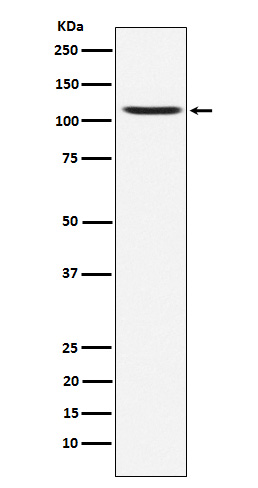

Anti-GluA4 antibody [R08-7G9] (STJA0036892)
SPECIFICATIONS
ClonalityMonoclonal
HostRabbit
ConjugationUnconjugated
IsotypeIgG
ImmunogenA synthesized peptide derived from human GluA4
General Information
| Short Description | Rabbit monoclonal anti-GluA4 for use in WB and FC in Human, Mouse and Rat samples. Datasheet included with dilution recommendations, and related reagents. |
| Applications | WB/FC |
| Host | Rabbit |
| Reactivity | Human/Mouse/Rat |
| Note | STRICTLY FOR FURTHER SCIENTIFIC RESEARCH USE ONLY (RUO). MUST NOT TO BE USED IN DIAGNOSTIC OR THERAPEUTIC APPLICATIONS. |
Product Properties
| Clonality | Monoclonal |
| Clone ID | R08-7G9 |
| Isotype | IgG |
| Conjugation | Unconjugated |
| Purification | Affinity Chromatography |
| Dilution Range | WB 1:500-1:1000FC 1:50-1:100 |
| Formulation | Rabbit IgG in phosphate buffered saline, pH 7.4, 150mM NaCl, 0.02% sodium azide and 50% glycerol. |
| Storage Instruction | Store at 4°C short term. Aliquot and store at-20°C long term. Avoid freeze/thaw cycles. |
Target Information
| Gene Symbol | GRIA4 |
| Gene ID | 2893 |
| Uniprot ID | GRIA4_HUMAN |
| Immunogen | A synthesized peptide derived from human GluA4 |
Additional Info
| Post Translational Modifications | Palmitoylated. Depalmitoylated upon L-glutamate stimulation. Cys-611 palmitoylation leads to Golgi retention and decreased cell surface expression. In contrast, Cys-837 palmitoylation does not affect cell surface expression but regulates stimulation-dependent endocytosis. Phosphorylated at Ser-862 by PRKCG.phosphorylation increases plasma membrane-associated GRI4 expression. |
| Function | Ionotropic glutamate receptor that functions as a ligand-gated cation channel, gated by L-glutamate and glutamatergic agonists such as alpha-amino-3-hydroxy-5-methyl-4-isoxazolepropionic acid (AMPA), quisqualic acid, and kainic acid. L-glutamate acts as an excitatory neurotransmitter at many synapses in the central nervous system and plays an important role in fast excitatory synaptic transmission. Binding of the excitatory neurotransmitter L-glutamate induces a conformation change, leading to the opening of the cation channel, and thereby converts the chemical signal to an electrical impulse upon entry of monovalent and divalent cations such as sodium and calcium. The receptor then desensitizes rapidly and enters a transient inactive state, characterized by the presence of bound agonist. In the presence of CACNG8, shows resensitization which is characterized by a delayed accumulation of current flux upon continued application of L-glutamate. |
| Protein Name | Glutamate Receptor 4Glur-4Glur4Ampa-Selective Glutamate Receptor 4Glur-DGlutamate Receptor Ionotropic - Ampa 4 |
| Database Links | Reactome: R-HSA-399710Reactome: R-HSA-399719Reactome: R-HSA-416993Reactome: R-HSA-438066Reactome: R-HSA-8849932 |
| Cellular Localisation | Cell MembraneMulti-Pass Membrane ProteinPostsynaptic Cell MembraneCell ProjectionDendrite |
| Alternative Antibody Names | Anti-Glutamate Receptor 4 antibodyAnti-Glur-4 antibodyAnti-Glur4 antibodyAnti-Ampa-Selective Glutamate Receptor 4 antibodyAnti-Glur-D antibodyAnti-Glutamate Receptor Ionotropic - Ampa 4 antibodyAnti-GRIA4 antibodyAnti-GluA4 antibodyAnti-GLUR4 antibody |
Information sourced from Uniprot.org