

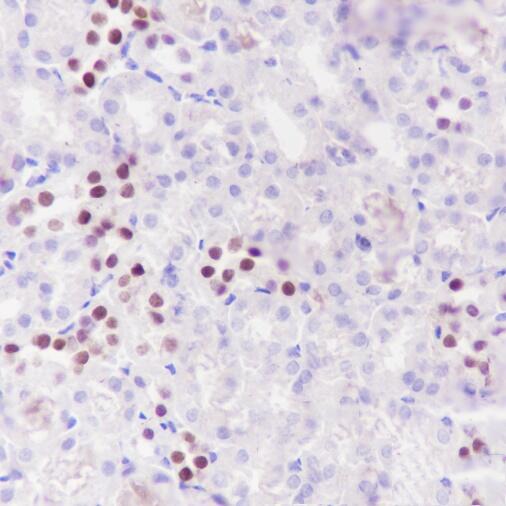

Anti-GATA3 antibody [R01-7I-9] (STJA0033063)
SPECIFICATIONS
ClonalityMonoclonal
HostMouse
ConjugationUnconjugated
IsotypeIgG2bk
ImmunogenPeptide
General Information
| Short Description | Mouse monoclonal anti-GATA3 for use in IHC-P in Human and Mouse samples. Datasheet included with dilution recommendations, and related reagents. |
| Applications | IHC-P |
| Host | Mouse |
| Reactivity | Human/Mouse |
| Note | STRICTLY FOR FURTHER SCIENTIFIC RESEARCH USE ONLY (RUO). MUST NOT TO BE USED IN DIAGNOSTIC OR THERAPEUTIC APPLICATIONS. |
Product Properties
| Clonality | Monoclonal |
| Clone ID | R01-7I-9 |
| Isotype | IgG2bk |
| Conjugation | Unconjugated |
| Purification | Protein G |
| Dilution Range | IHC-P 1:50-1:100 |
| Formulation | Liquid in PBS, Glycerol and BSA |
| Storage Instruction | Store at-20°C. Avoid freeze/thaw cycles. |
Target Information
| Gene Symbol | GATA3 |
| Gene ID | 2625 |
| Uniprot ID | GATA3_HUMAN |
| Immunogen | Peptide |
Additional Info
| Tissue Specificity | T-cells and endothelial cells. |
| Function | Transcriptional activator which binds to the enhancer of the T-cell receptor alpha and delta genes. Binds to the consensus sequence 5'-AGATAG-3'. Required for the T-helper 2 (Th2) differentiation process following immune and inflammatory responses. Positively regulates ASB2 expression. Coordinates macrophage transcriptional activation and UCP2-dependent metabolic reprogramming in response to IL33. Upon tissue injury, acts downstream of IL33 signaling to drive differentiation of inflammation-resolving alternatively activated macrophages. |
| Protein Name | Trans-Acting T-Cell-Specific Transcription Factor Gata-3Gata-Binding Factor 3 |
| Database Links | Reactome: R-HSA-5689880Reactome: R-HSA-6785807Reactome: R-HSA-8939236Reactome: R-HSA-9018519Reactome: R-HSA-9830364Reactome: R-HSA-983231 |
| Cellular Localisation | Nucleus |
| Alternative Antibody Names | Anti-Trans-Acting T-Cell-Specific Transcription Factor Gata-3 antibodyAnti-Gata-Binding Factor 3 antibodyAnti-GATA3 antibody |
Information sourced from Uniprot.org