


Anti-GABBR2 antibody (N-Term) (STJA0005687)
SPECIFICATIONS
ClonalityPolyclonal
HostRabbit
ConjugationUnconjugated
IsotypeIgG
ImmunogenSynthetic peptide corresponding to amino acids from the N-terminal region of human GABABR2 protein
General Information
| Short Description | Rabbit polyclonal anti-GABABR2 (N-Term) for use in WB in Human, Mouse and Rat samples. Datasheet included with dilution recommendations, and related reagents. |
| Applications | WB |
| Host | Rabbit |
| Reactivity | Human/Mouse/Rat |
| Note | STRICTLY FOR FURTHER SCIENTIFIC RESEARCH USE ONLY (RUO). MUST NOT TO BE USED IN DIAGNOSTIC OR THERAPEUTIC APPLICATIONS. |
Product Properties
| Clonality | Polyclonal |
| Isotype | IgG |
| Conjugation | Unconjugated |
| Purification | Antigen Affinity Purified |
| Dilution Range | WB 1:500-1:1000 |
| Formulation | PBS + 0.02% NaN3 |
| Storage Instruction | Store at-20°C for up to 1 year from the date of receipt, and avoid repeat freeze-thaw cycles. |
Target Information
| Gene Symbol | GABBR2 |
| Gene ID | 9568 |
| Uniprot ID | GABR2_HUMAN |
| Immunogen | Synthetic peptide corresponding to amino acids from the N-terminal region of human GABABR2 protein |
| Immunogen Region | N-Term |
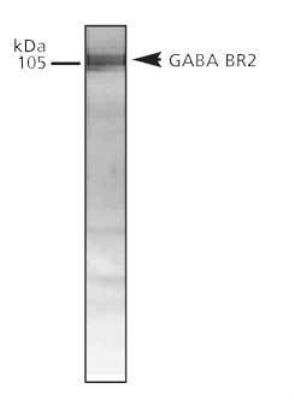
| Specificity | Reacts with the N-terminal region of the 105 kDa GABABR2 protein. |
Additional Info
| Function | Component of a heterodimeric G-protein coupled receptor for GABA, formed by GABBR1 and GABBR2. Within the heterodimeric GABA receptor, only GABBR1 seems to bind agonists, while GABBR2 mediates coupling to G proteins. Ligand binding causes a conformation change that triggers signaling via guanine nucleotide-binding proteins (G proteins) and modulates the activity of down-stream effectors, such as adenylate cyclase. Signaling inhibits adenylate cyclase, stimulates phospholipase A2, activates potassium channels, inactivates voltage-dependent calcium-channels and modulates inositol phospholipid hydrolysis. Plays a critical role in the fine-tuning of inhibitory synaptic transmission. Pre-synaptic GABA receptor inhibits neurotransmitter release by down-regulating high-voltage activated calcium channels, whereas postsynaptic GABA receptor decreases neuronal excitability by activating a prominent inwardly rectifying potassium (Kir) conductance that underlies the late inhibitory postsynaptic potentials. Not only implicated in synaptic inhibition but also in hippocampal long-term potentiation, slow wave sleep, muscle relaxation and antinociception (Probable). |
| Protein Name | Gamma-Aminobutyric Acid Type B Receptor Subunit 2Gaba-B Receptor 2Gaba-B-R2Gaba-Br2Gababr2Gb2G-Protein Coupled Receptor 51Hg20 |
| Database Links | Reactome: R-HSA-1296041Reactome: R-HSA-418594Reactome: R-HSA-420499Reactome: R-HSA-977444Reactome: R-HSA-997272 |
| Cellular Localisation | Cell MembraneMulti-Pass Membrane ProteinPostsynaptic Cell MembraneCoexpression Of Gabbr1 And Gabbr2 Is Required For Gabbr1 Maturation And Transport To The Plasma MembraneIn ContrastGabbr2 Does Not Depend On Gabbr1 For Transport To The Cell Membrane |
| Alternative Antibody Names | Anti-Gamma-Aminobutyric Acid Type B Receptor Subunit 2 antibodyAnti-Gaba-B Receptor 2 antibodyAnti-Gaba-B-R2 antibodyAnti-Gaba-Br2 antibodyAnti-Gababr2 antibodyAnti-Gb2 antibodyAnti-G-Protein Coupled Receptor 51 antibodyAnti-Hg20 antibodyAnti-GABBR2 antibodyAnti-GPR51 antibodyAnti-GPRC3B antibody |
Information sourced from Uniprot.org