
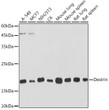


Anti-Destrin antibody (1-100) [S5MR] (STJ11103125)
SPECIFICATIONS
ClonalityMonoclonal
HostRabbit
ConjugationUnconjugated
IsotypeIgG
General Information
| Short Description | Rabbit monoclonal Destrin (1-100) antibody for use in WB and ELISA in human, mouse and rat samples. Datasheet included with dilution recommendations, and related reagents. |
| Applications | WB/ELISA |
| Host | Rabbit |
| Reactivity | Human/Mouse/Rat |
| Note | STRICTLY FOR FURTHER SCIENTIFIC RESEARCH USE ONLY (RUO). MUST NOT TO BE USED IN DIAGNOSTIC OR THERAPEUTIC APPLICATIONS. |
Product Properties
| Clonality | Monoclonal |
| Clone ID | S5MR |
| Isotype | IgG |
| Conjugation | Unconjugated |
| Concentration | Lot specific |
| Purification | Affinity purification |
| Dilution Range | WB:1:500-1:1000ELISA:Recommended starting concentration is 1 Mu g/mL. Please optimize the concentration based on your specific assay requirements. |
| Formulation | PBS with 0.02% Sodium Azide, 0.05% BSA, 50% Glycerol, pH 7.3. |
| Storage Instruction | Store at-20°C for up to 1 year from the date of receipt, and avoid repeat freeze-thaw cycles. |
Target Information
| Gene Symbol | DSTN |
| Gene ID | 11034 |
| Uniprot ID | DEST_HUMAN |
| Immunogen Region | 1-100 |
| Immunogen Sequence | MASGVQVADEVCRIFYDMKV RKCSTPEEIKKRKKAVIFCL SADKKCIIVEEGKEILVGDV GVTITDPFKHFVGMLPEKDC RYALYDASFETKESRKEELM |
| Specificity | A synthetic peptide corresponding to a sequence within amino acids 1-100 of human Destrin (P60981). |
Additional Info
| Tissue Specificity | Widely distributed in various tissues. |
| Post Translational Modifications | ISGylated. |
| Function | Actin-depolymerizing protein. Severs actin filaments (F-actin) and binds to actin monomers (G-actin). Acts in a pH-independent manner. |
| Protein Name | DestrinActin-Depolymerizing FactorAdf |
| Database Links | |
| Cellular Localisation | |
| Alternative Antibody Names | Anti-Destrin antibodyAnti-Actin-Depolymerizing Factor antibodyAnti-Adf antibodyAnti-DSTN antibodyAnti-ACTDP antibodyAnti-DSN antibody |
Information sourced from Uniprot.org