

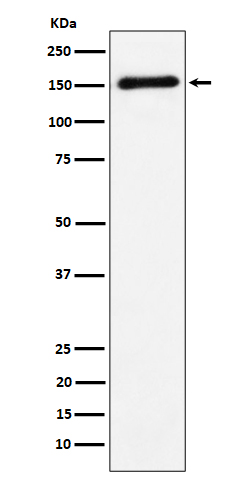

Anti-BIG-2 antibody [R64-9A-8] (STJA0035552)
SPECIFICATIONS
ClonalityMonoclonal
HostRabbit
ConjugationUnconjugated
IsotypeIgG
ImmunogenA synthesized peptide derived from human CNTN4
General Information
| Short Description | Rabbit monoclonal anti-BIG-2 for use in WB and IHC-P in Human samples. Datasheet included with dilution recommendations, and related reagents. |
| Applications | WB/IHC-P |
| Host | Rabbit |
| Reactivity | Human |
| Note | STRICTLY FOR FURTHER SCIENTIFIC RESEARCH USE ONLY (RUO). MUST NOT TO BE USED IN DIAGNOSTIC OR THERAPEUTIC APPLICATIONS. |
Product Properties
| Clonality | Monoclonal |
| Clone ID | R64-9A-8 |
| Isotype | IgG |
| Conjugation | Unconjugated |
| Purification | Affinity Chromatography |
| Dilution Range | WB 1:500-1:1000IHC 1:100-1:200 |
| Formulation | Liquid in PBS, pH 7.4, 150mM NaCl, 0.02% sodium azide and 50% glycerol. |
| Storage Instruction | Store at 4°C short term. Aliquot and store at-20°C long term. Avoid freeze/thaw cycles. |
Target Information
| Gene Symbol | CNTN4 |
| Gene ID | 152330 |
| Uniprot ID | CNTN4_HUMAN |
| Immunogen | A synthesized peptide derived from human CNTN4 |
Additional Info
| Tissue Specificity | Mainly expressed in brain. Highly expressed in cerebellum and weakly expressed in corpus callosum, caudate nucleus, amygdala and spinal cord. Also expressed in testis, pancreas, thyroid, uterus, small intestine and kidney. Not expressed in skeletal muscle. Isoform 2 is weakly expressed in cerebral cortex. |
| Function | Contactins mediate cell surface interactions during nervous system development. Has some neurite outgrowth-promoting activity. May be involved in synaptogenesis. |
| Protein Name | Contactin-4Brain-Derived Immunoglobulin Superfamily Protein 2Big-2 |
| Database Links | Reactome: R-HSA-163125 |
| Cellular Localisation | Cell MembraneLipid-AnchorGpi-AnchorSecreted |
| Alternative Antibody Names | Anti-Contactin-4 antibodyAnti-Brain-Derived Immunoglobulin Superfamily Protein 2 antibodyAnti-Big-2 antibodyAnti-CNTN4 antibody |
Information sourced from Uniprot.org