

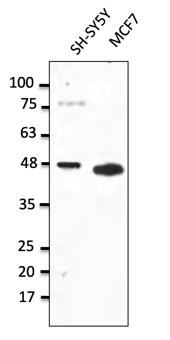

Anti-ATXN3 antibody (120-250aa) (STJ140015)
SPECIFICATIONS
ClonalityPolyclonal
HostGoat
ConjugationUnconjugated
IsotypeIgG
ImmunogenPurified recombinant peptide derived from within residues 120 aa to 250 aa of human ATXN3 produced in E. coli.
General Information
| Short Description | Goat polyclonal Ataxin 3 (120-250aa) antibody for use in WB in human, mouse, rat, bovine, canine, chicken, avian, donkey, feline, goat, guinea pig, hamster, horse, porcine, rabbit, sheep and simian samples. Datasheet included with dilution recommenda |
| Applications | WB |
| Host | Goat |
| Reactivity | Human/Mouse/Rat/Bovine/Canine/Chicken/Avian/Donkey/Feline/Goat/Guinea Pig/Hamster/Horse/Porcine/Rabbit/Sheep/Simian |
| Note | STRICTLY FOR FURTHER SCIENTIFIC RESEARCH USE ONLY (RUO). MUST NOT TO BE USED IN DIAGNOSTIC OR THERAPEUTIC APPLICATIONS. |
Product Properties
| Clonality | Polyclonal |
| Isotype | IgG |
| Conjugation | Unconjugated |
| Concentration | 3 mg/mL |
| Purification | This antibody is epitope-affinity purified from goat antiserum. |
| Dilution Range | WB 1:250-1:2000 |
| Formulation | PBS, 20% Glycerol and 0.05% Sodium Azide. |
| Storage Instruction | For continuous use, store at 2-8 C for one-two days. For extended storage, store in-20 C freezer. Working dilution samples should be discarded if not used within 12 hours. |
Target Information
| Gene Symbol | ATXN3 |
| Gene ID | 4287 |
| Uniprot ID | ATX3_HUMAN |
| Accession Number | ENSG00000066427 |
| Immunogen | Purified recombinant peptide derived from within residues 120 aa to 250 aa of human ATXN3 produced in E. coli. |
| Immunogen Region | 120-250aa |
| Immunogen Sequence | KEHWFTVRKLGKQWFNLNSL EHWFTVRKLGKQWFNLNSLL HWFTVRKLGKQWFNLNSLLT WFTVRKLGKQWFNLNSLLTG FTVRKLGKQWFNLNSLLTGP TVRKLGKQWFNLNSLLTGPE VRKLGKQWFNLNSLLTGPEL |
| Specificity | Detects levels of ATXN3 protein in transfected cells with GFP-ATXN3 and endogenous levels in U118, SH-SY5Y, At-T20 and hTERT cell lysates by Western blot. |
Additional Info
| Tissue Specificity | Ubiquitous. |
| Post Translational Modifications | Monoubiquitinated N-terminally by UBE2W, possibly leading to activate the deubiquitinating enzyme activity. |
| Function | Deubiquitinating enzyme involved in protein homeostasis maintenance, transcription, cytoskeleton regulation, myogenesis and degradation of misfolded chaperone substrates. Binds long polyubiquitin chains and trims them, while it has weak or no activity against chains of 4 or less ubiquitins. Involved in degradation of misfolded chaperone substrates via its interaction with STUB1/CHIP: recruited to monoubiquitinated STUB1/CHIP, and restricts the length of ubiquitin chain attached to STUB1/CHIP substrates and preventing further chain extension. Interacts with key regulators of transcription and represses transcription: acts as a histone-binding protein that regulates transcription. Acts as a negative regulator of mTORC1 signaling in response to amino acid deprivation by mediating deubiquitination of RHEB, thereby promoting RHEB inactivation by the TSC-TBC complex. Regulates autophagy via the deubiquitination of 'Lys-402' of BECN1 leading to the stabilization of BECN1. |
| Protein Name | Ataxin-3Machado-Joseph Disease Protein 1Spinocerebellar Ataxia Type 3 Protein |
| Database Links | Reactome: R-HSA-5689877Reactome: R-HSA-9615017 |
| Cellular Localisation | Nucleus MatrixNucleusLysosome MembranePeripheral Membrane ProteinPredominantly NuclearBut Not ExclusivelyInner Nuclear MatrixRecruited To Lysosomal Membrane In Response To Amino Acid Deprivation By The Raga/Rraga-Ragb/Rragb Complex |
| Alternative Antibody Names | Anti-Ataxin-3 antibodyAnti-Machado-Joseph Disease Protein 1 antibodyAnti-Spinocerebellar Ataxia Type 3 Protein antibodyAnti-ATXN3 antibodyAnti-ATX3 antibodyAnti-MJD antibodyAnti-MJD1 antibodyAnti-SCA3 antibody |
Information sourced from Uniprot.org