
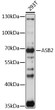


Anti-ASB2 antibody (448-587) (STJ119909)
SPECIFICATIONS
ClonalityPolyclonal
HostRabbit
ConjugationUnconjugated
IsotypeIgG
General Information
| Short Description | Rabbit polyclonal ASB2 (448-587) antibody for use in WB and ELISA in human and rat samples. Datasheet included with dilution recommendations, and related reagents. |
| Applications | WB/ELISA |
| Host | Rabbit |
| Reactivity | Human/Rat |
| Note | STRICTLY FOR FURTHER SCIENTIFIC RESEARCH USE ONLY (RUO). MUST NOT TO BE USED IN DIAGNOSTIC OR THERAPEUTIC APPLICATIONS. |
Product Properties
| Clonality | Polyclonal |
| Isotype | IgG |
| Conjugation | Unconjugated |
| Concentration | Lot specific |
| Purification | Affinity purification |
| Dilution Range | WB:1:500-1:2000ELISA:Recommended starting concentration is 1 Mu g/mL. Please optimize the concentration based on your specific assay requirements. |
| Formulation | PBS with 0.01% Thimerosal, 50% Glycerol, pH 7.3. |
| Storage Instruction | Store at-20°C for up to 1 year from the date of receipt, and avoid repeat freeze-thaw cycles. |
Target Information
| Gene Symbol | ASB2 |
| Gene ID | 51676 |
| Uniprot ID | ASB2_HUMAN |
| Immunogen Region | 448-587 |
| Immunogen Sequence | MDLGCDGEPCFSCLYGNGPH PPAPQPSSRFNDAPAADKEP SVVQFCEFVSAPEVSRWAGP IIDVLLDYVGNVQLCSRLKE HIDSFEDWAVIKEKAEPPRP LAHLCRLRVRKAIGKYRIKL LDTLPLPGRLIRYLKYENTQ |
| Specificity | Recombinant fusion protein containing a sequence corresponding to amino acids 448-587 of human ASB2 (NP_057234.2). |
Additional Info
| Tissue Specificity | Isoform 1: Expressed in muscle cells. Isoform 2: Expressed in hematopoietic cells. |
| Post Translational Modifications | Isoform 1: Monoubiquitinated. Isoform 2: Not monoubiquitinated. Isoform 2: Phosphorylation at Ser-371 is required for association with FLNA and subsequent FLNA degradation. |
| Function | Substrate-recognition component of a SCF-like ECS (Elongin-Cullin-SOCS-box protein) E3 ubiquitin-protein ligase complex which mediates the ubiquitination and subsequent proteasomal degradation of target proteins. Mediates Notch-induced ubiquitination and degradation of substrates including TCF3/E2A and JAK2. Required during embryonic heart development for complete heart looping. Required for cardiomyocyte differentiation. Specifically promotes the ubiquitination of SMAD9 and targets it for proteasomal degradation, leading to avoid excessive accumulation of SMAD9. Plays a role in the regulation of NK-cell migration by modulating protein levels of filamin A/FLNA via regulation of its ubiquitination and proteasome degradation. Isoform 1: Involved in myogenic differentiation and targets filamin FLNB for proteasomal degradation but not filamin FLNA. Also targets DES for proteasomal degradation. Acts as a negative regulator of skeletal muscle mass. Isoform 2: Targets filamins FLNA and FLNB for proteasomal degradation. This leads to enhanced adhesion of hematopoietic cells to fibronectin. Required for FLNA degradation in immature cardiomyocytes which is necessary for actin cytoskeleton remodeling, leading to proper organization of myofibrils and function of mature cardiomyocytes. Required for degradation of FLNA and FLNB in immature dendritic cells (DC) which enhances immature DC migration by promoting DC podosome formation and DC-mediated degradation of the extracellular matrix. Does not promote proteasomal degradation of tyrosine-protein kinases JAK1 or JAK2 in hematopoietic cells. |
| Protein Name | Ankyrin Repeat And Socs Box Protein 2Asb-2 |
| Database Links | Reactome: R-HSA-8951664Reactome: R-HSA-983168 |
| Cellular Localisation | CytoplasmCytoskeletonStress FiberIsoform 1: CytoplasmMyofibrilSarcomereZ LineLocalizes To The Z Line In Cardiomyocytes |
| Alternative Antibody Names | Anti-Ankyrin Repeat And Socs Box Protein 2 antibodyAnti-Asb-2 antibodyAnti-ASB2 antibody |
Information sourced from Uniprot.org