


Anti-ALDH1A1 antibody (N-Term) [M562] (STJA0041059)
SPECIFICATIONS
ClonalityMonoclonal
HostMouse
ConjugationUnconjugated
IsotypeIgG2a
ImmunogenClone M562 was generated from a recombinant protein corresponding to amino acids in the N-terminal region from human ALDH1A1.
General Information
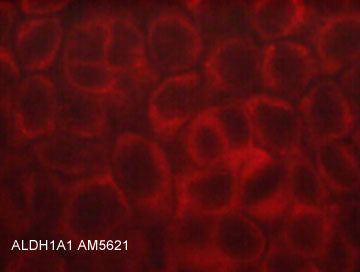
| Short Description | Mouse monoclonal anti-ALDH1A1 (N-Term) for use in ELISA, WB and ICC in Human samples. Datasheet included with dilution recommendations, and related reagents. |
| Applications | ELISA/WB/ICC |
| Host | Mouse |
| Reactivity | Human |
| Note | STRICTLY FOR FURTHER SCIENTIFIC RESEARCH USE ONLY (RUO). MUST NOT TO BE USED IN DIAGNOSTIC OR THERAPEUTIC APPLICATIONS. |
Product Properties
| Clonality | Monoclonal |
| Clone ID | M562 |
| Isotype | IgG2a |
| Conjugation | Unconjugated |
| Purification | Protein G Purified |
| Dilution Range | WB 1:1000ICC 1:100 |
| Formulation | PBS + 1 mg/ml BSA, 0.05% NaN3 and 50% glycerol |
| Storage Instruction | Storage at-20°C is recommended, as aliquots may be taken without freeze/thawing due to presence of 50% glycerol. Stable for at least 1 year at-20°C. |
Target Information
| Gene Symbol | ALDH1A1 |
| Gene ID | 216 |
| Uniprot ID | AL1A1_HUMAN |
| Immunogen | Clone M562 was generated from a recombinant protein corresponding to amino acids in the N-terminal region from human ALDH1A1. |
| Immunogen Region | N-Term |
| Immunogen Sequence | Human |
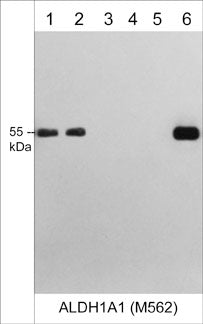
| Specificity | This antibody antibody detects a 55 kDa* protein on SDS-PAGE immunoblots of human A431, HepG2, and mouse liver, as well as human recombinant ALDH1A1. The antibody does not detect ALDH1A3 in PC3 cells, ALDH1A2 in Jurkat cells, and bovine tubulin (55 k |
Additional Info
| Tissue Specificity | Expressed by erythrocytes (at protein level). |
| Post Translational Modifications | The N-terminus is blocked most probably by acetylation. |
| Function | Cytosolic dehydrogenase that catalyzes the irreversible oxidation of a wide range of aldehydes to their corresponding carboxylic acid. Functions downstream of retinol dehydrogenases and catalyzes the oxidation of retinaldehyde into retinoic acid, the second step in the oxidation of retinol/vitamin A into retinoic acid. This pathway is crucial to control the levels of retinol and retinoic acid, two important molecules which excess can be teratogenic and cytotoxic. Also oxidizes aldehydes resulting from lipid peroxidation like (E)-4-hydroxynon-2-enal/HNE, malonaldehyde and hexanal that form protein adducts and are highly cytotoxic. By participating for instance to the clearance of (E)-4-hydroxynon-2-enal/HNE in the lens epithelium prevents the formation of HNE-protein adducts and lens opacification. Also functions downstream of fructosamine-3-kinase in the fructosamine degradation pathway by catalyzing the oxidation of 3-deoxyglucosone, the carbohydrate product of fructosamine 3-phosphate decomposition, which is itself a potent glycating agent that may react with lysine and arginine side-chains of proteins. Also has an aminobutyraldehyde dehydrogenase activity and is probably part of an alternative pathway for the biosynthesis of GABA/4-aminobutanoate in midbrain, thereby playing a role in GABAergic synaptic transmission. |
| Protein Name | Aldehyde Dehydrogenase 1a1 3-Deoxyglucosone DehydrogenaseAldh-E1AlhdiiAldehyde Dehydrogenase Family 1 Member A1Aldehyde Dehydrogenase - CytosolicRetinal Dehydrogenase 1Raldh 1Raldh1 |
| Database Links | Reactome: R-HSA-5365859Reactome: R-HSA-70350Reactome: R-HSA-71384 |
| Cellular Localisation | CytoplasmCytosolCell ProjectionAxon |
| Alternative Antibody Names | Anti-Aldehyde Dehydrogenase 1a1 antibodyAnti-3-Deoxyglucosone Dehydrogenase antibodyAnti-Aldh-E1 antibodyAnti-Alhdii antibodyAnti-Aldehyde Dehydrogenase Family 1 Member A1 antibodyAnti-Aldehyde Dehydrogenase - Cytosolic antibodyAnti-Retinal Dehydrogenase 1 antibodyAnti-Raldh 1 antibodyAnti-Raldh1 antibodyAnti-ALDH1A1 antibodyAnti-ALDC antibodyAnti-ALDH1 antibodyAnti-PUMB1 antibody |
Information sourced from Uniprot.org