
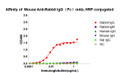


Mouse Anti-Rabbit IgG Heavy chain (96-323 aa) antibody {HRP} (STJS001224)
SPECIFICATIONS
ClonalityMonoclonal
HostMouse
ConjugationHRP
IsotypeIgG1
General Information
| Short Description | HRP-conjugated mouse monoclonal anti-Rabbit IgG Heavy chain 96-323 aa secondary antibody. For use in most research applications. |
| Applications | WB/ELISA |
| Host | Mouse |
| Reactivity | Rabbit |
| Note | STRICTLY FOR FURTHER SCIENTIFIC RESEARCH USE ONLY (RUO). MUST NOT TO BE USED IN DIAGNOSTIC OR THERAPEUTIC APPLICATIONS. |
Product Properties
| Clonality | Monoclonal |
| Clone ID | SMM15551 |
| Isotype | IgG1 |
| Conjugation | HRP |
| Concentration | Lot specific |
| Purification | Affinity purification |
| Dilution Range | WB:1:5000-1:20000ELISA: 1:5000-1:10000 |
| Formulation | PBS with 0.09% Sodium Azide, 50% Glycerol, pH 7.3. |
| Storage Instruction | Store at-20°C for up to 1 year from the date of receipt, and avoid repeat freeze-thaw cycles. |
Target Information
| Immunogen Region | 96-323 aa |
| Specificity | Recombinant fusion protein containing a sequence corresponding to amino acids 96-323 of rabbit IgG (Fc) (P01870). |
Additional Info
| Background | Secondary antibodies are affinity-purified antibodies which will work with target-specific primary antibody in the detection, sorting or purification of its specified target. Secondary antibodies offer increased versatility enabling users to use many detection systems (e.g. HRP, AP, fluorescence). They can also provide greater sensitivity through signal amplification as multiple secondary antibodies. Most commonly, secondary antibodies are generated by immunizing the host animal (different from host species of primary antibody) with a pooled population of normal immunoglobulins from the host species of primary antibody and can be further purified and modified (i.e. antibody fragmentation, label conjugation, etc.) to ensure well-characterized specificity to corresponding normal immunoglobulins. |
Information sourced from Uniprot.org