

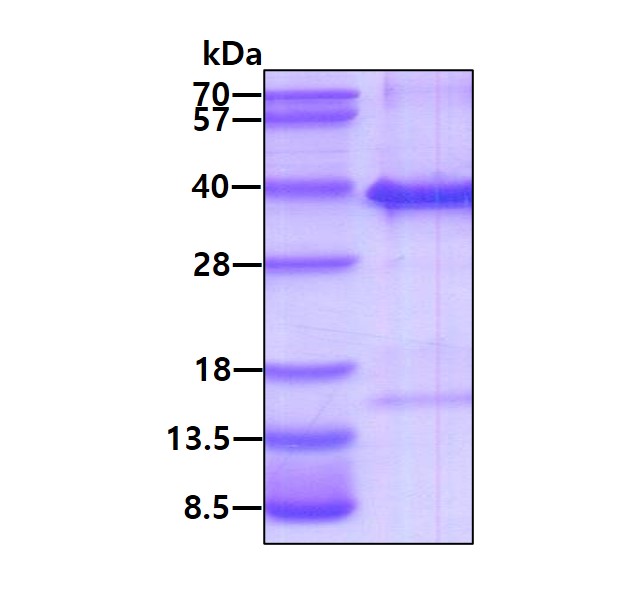

Human TRAM/TICAM2 protein (Recombinant) (His-Tag) (STJP017525)
SPECIFICATIONS
HostE.coli
ImmunogenHuman
General Information
| Short Description | Recombinant-Human TRAM/TICAM2-His-Tag protein was developed from e.coli and has a target region of His-Tag. For use in research applications. |
| Applications | SDS-PAGE |
| Host | E.coli |
| Note | STRICTLY FOR FURTHER SCIENTIFIC RESEARCH USE ONLY (RUO). MUST NOT TO BE USED IN DIAGNOSTIC OR THERAPEUTIC APPLICATIONS. |
Product Properties
| Concentration | 1 mg/mL |
| Formulation | Liquid in 20mM Tris-HCl buffer (pH 8.0) containing 1mM DTT, 10% Glycerol, 0.1M NaCl |
| Storage Instruction | For short term storage, keep at +2C to +8C for up to 1 week. For long term storage, aliquot and store at-20C, and avoid repeat freeze-thaw cycles. |
Target Information
| Gene Symbol | TICAM2 |
| Gene ID | 100302736/353376 |
| Uniprot ID | TCAM2_HUMAN |
| Accession Number | NP_067681.1 |
| Immunogen | Human |
| Immunogen Region | 1-235aa |
| Immunogen Sequence |
Additional Info
| Tissue Specificity | Expressed in spleen, prostate, testis, uterus, small intestine, colon, peripheral blood leukocytes, heart, placenta, lung, liver, skeletal muscle, and pancreas Isoform 2 is ubiquitously expressed (at lower levels than isoform 1). |
| Post Translational Modifications | Phosphorylated by PRKCE in response to LPS. Phosphorylation is essential for its function. It is depleted from the membrane upon phosphorylation. Tyrosine phosphorylation is inhibited by phosphatase PTPN4. Isoform 1 is myristoylated. Required for membrane association which is critical for its ability to initiate efficient signaling. |
| Function | Functions as a sorting adapter in different signaling pathways to facilitate downstream signaling leading to type I interferon induction. In TLR4 signaling, physically bridges TLR4 and TICAM1 and functionally transmits signal to TICAM1 in early endosomes after endocytosis of TLR4. In TLR2 signaling, physically bridges TLR2 and MYD88 and is required for the TLR2-dependent movement of MYD88 to endosomes following ligand engagement. Involved in IL-18 signaling and is proposed to function as a sorting adapter for MYD88 in IL-18 signaling during adaptive immune response. Forms a complex with RAB11FIP2 that is recruited to the phagosomes to promote the activation of the actin-regulatory GTPases RAC1 and CDC42 and subsequent phagocytosis of Gram-negative bacteria. Isoform 2: Proposed to inhibit LPS-TLR4 signaling at the late endosome by interaction with isoform 1 thereby disrupting the association of isoform 1 with TICAM1. May be involved in TLR4 degradation in late endosomes. |
| Protein Name | Tir Domain-Containing Adapter Molecule 2Ticam-2Putative Nf-Kappa-B-Activating Protein 502Trif-Related Adapter MoleculeToll-Like Receptor Adaptor Protein 3Toll/Interleukin-1 Receptor Domain-Containing ProteinMyd88-4 |
| Database Links | Reactome: R-HSA-140534Reactome: R-HSA-166016Reactome: R-HSA-166166Reactome: R-HSA-2562578Reactome: R-HSA-6798695Reactome: R-HSA-936964Reactome: R-HSA-937041Reactome: R-HSA-937072Reactome: R-HSA-975163Reactome: R-HSA-9824878 |
| Cellular Localisation | Isoform 1: CytoplasmGolgi ApparatusCell MembraneEndoplasmic ReticulumEarly Endosome MembraneLate Endosome MembraneCell ProjectionPhagocytic CupLocalized To The Plasma Membrane As A Result Of MyristoylationPhosphorylation On Ser-16 Leads To Its Depletion From The MembraneUpon Lps Stimulation Colcoalizes With Isoform 2 In Late EndosomesIsoform 2: Endoplasmic ReticulumTranslocates To Late Endosomes Upon Lps Stimulation Where It Colcoalizes With Isoform 1 |
| Alternative Protein Names | Tir Domain-Containing Adapter Molecule 2 proteinTicam-2 proteinPutative Nf-Kappa-B-Activating Protein 502 proteinTrif-Related Adapter Molecule proteinToll-Like Receptor Adaptor Protein 3 proteinToll/Interleukin-1 Receptor Domain-Containing Protein proteinMyd88-4 proteinTICAM2 proteinTIRAP3 proteinTIRP proteinTRAM protein |
Information sourced from Uniprot.org