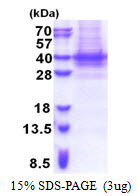


| Short Description : | Recombinant-Human PIH1D1-His-Tag protein was developed from e.coli and has a target region of His-Tag. For use in research applications. |
| Applications: | SDS-PAGE/Denatured |
| Host: | E.coli |
| Note: | STRICTLY FOR FURTHER SCIENTIFIC RESEARCH USE ONLY (RUO). MUST NOT TO BE USED IN DIAGNOSTIC OR THERAPEUTIC APPLICATIONS. |
| Concentration: | 0.25 mg/mL |
| Formulation: | Liquid in 20mM Tris-HCl buffer (pH 8.0) containing 10% Glycerol 0.4M urea |
| Storage Instruction: | For short term storage, keep at +2C to +8C for up to 1 week. For long term storage, aliquot and store at-20C, and avoid repeat freeze-thaw cycles. |
| Gene Symbol: | PIH1D1 |
| Gene ID: | 55011 |
| Uniprot ID: | PIHD1_HUMAN |
| Accession Number: | NP_060386 |
| Immunogen: | Human |
| Immunogen Region: | 1-290aa |
| Immunogen Sequence: | MGSSHHHHHH SSGLVPRGSH MGSMANPKLL GMGLSEAEAI GADSARFEEL LLQASKELQQ AQTTRPESTQ IQPQPGFCIK TNSSEGKVFI NICHSPSIPP PADVTEEELL QMLEEDQAGF RIPMSLGEPH AELDAKGQGC TAYDVAVNSD FYRRMQNSDF LRELVITIAR EGLEDKYNLQ LNPEWRMMKN RPFMGSISQQ NIRSEQRPRI QELGDLYTPA PGRAESGP |
| Tissue Specificity | Expressed at low levels in normal mammary epithelial cells (at protein level). Highest expression in lung, leukocyte and placenta. Expressed at lower levels in brain, prostate, colon, heart, small intestine, liver, ovary, pancreas, skeletal muscle, spleen, testis and thymus. |
| Function | Involved in the assembly of C/D box small nucleolar ribonucleoprotein (snoRNP) particles. Recruits the SWI/SNF complex to the core promoter of rRNA genes and enhances pre-rRNA transcription. Mediates interaction of TELO2 with the R2TP complex which is necessary for the stability of MTOR and SMG1. Positively regulates the assembly and activity of the mTORC1 complex. |
| Protein Name | Pih1 Domain-Containing Protein 1Nucleolar Protein 17 Homolog |
| Database Links | |
| Cellular Localisation | Nucleus |
| Alternative Protein Names | Pih1 Domain-Containing Protein 1 proteinNucleolar Protein 17 Homolog proteinPIH1D1 proteinNOP17 protein |
Information sourced from Uniprot.org