

Human OGG1 protein (Recombinant) (His-Tag) (STJP016808)
SPECIFICATIONS
HostE.coli
ImmunogenHuman
General Information
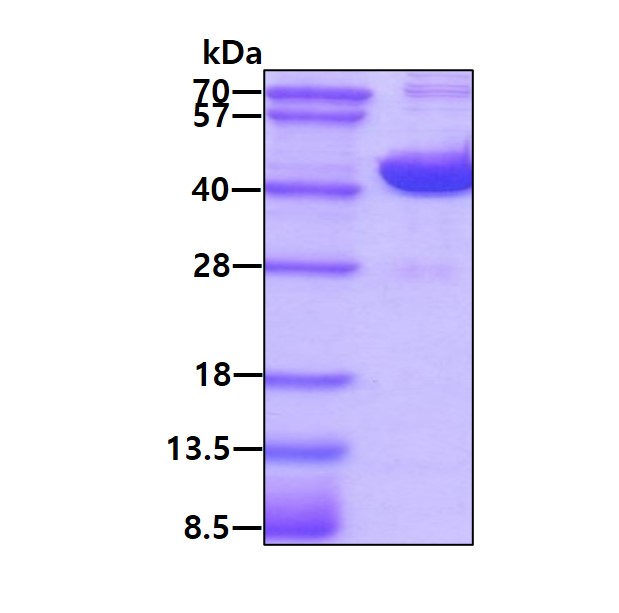
| Short Description | Recombinant-Human OGG1-His-Tag protein was developed from e.coli and has a target region of His-Tag. For use in research applications. |
| Applications | SDS-PAGE |
| Host | E.coli |
| Note | STRICTLY FOR FURTHER SCIENTIFIC RESEARCH USE ONLY (RUO). MUST NOT TO BE USED IN DIAGNOSTIC OR THERAPEUTIC APPLICATIONS. |
Product Properties
| Concentration | 0.5 mg/mL |
| Formulation | Liquid in phosphate-Buffered Saline (pH 7.4) containing 40% Glycerol |
| Storage Instruction | For short term storage, keep at +2C to +8C for up to 1 week. For long term storage, aliquot and store at-20C, and avoid repeat freeze-thaw cycles. |
Target Information
| Gene Symbol | OGG1 |
| Gene ID | 4968 |
| Uniprot ID | OGG1_HUMAN |
| Accession Number | AAH00657.1 |
| Immunogen | Human |
| Immunogen Region | 1-345aa |
| Immunogen Sequence |
Additional Info
| Tissue Specificity | Ubiquitous. |
| Function | DNA repair enzyme that incises DNA at 8-oxoG residues. Excises 7,8-dihydro-8-oxoguanine and 2,6-diamino-4-hydroxy-5-N-methylformamidopyrimidine (FAPY) from damaged DNA. Has a beta-lyase activity that nicks DNA 3' to the lesion. |
| Protein Name | N-Glycosylase/Dna Lyase Includes - 8-Oxoguanine Dna Glycosylase - Dna-(Apurinic Or Apyrimidinic Site LyaseAp Lyase |
| Database Links | Reactome: R-HSA-110328Reactome: R-HSA-110329Reactome: R-HSA-110330Reactome: R-HSA-110331Reactome: R-HSA-110357Reactome: R-HSA-5649702Reactome: R-HSA-9656255Reactome: R-HSA-9656256Reactome: R-HSA-9657050 O15527-4 |
| Cellular Localisation | NucleusNucleoplasmNucleus SpeckleNucleus MatrixTogether With Apex1 Is Recruited To Nuclear Speckles In Uva-Irradiated CellsIsoform 1a: NucleusIsoform 2a: Mitochondrion |
| Alternative Protein Names | N-Glycosylase/Dna Lyase Includes - 8-Oxoguanine Dna Glycosylase - Dna-(Apurinic Or Apyrimidinic Site Lyase proteinAp Lyase proteinOGG1 proteinMMH proteinMUTM proteinOGH1 protein |
Information sourced from Uniprot.org