

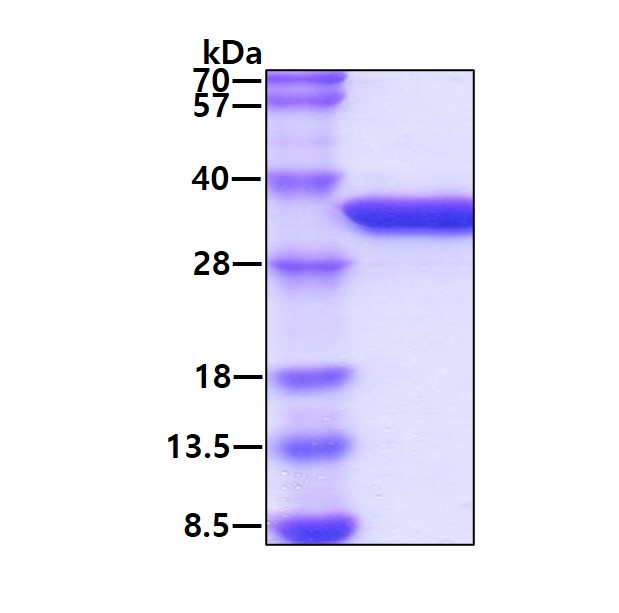

Human NQO1 protein (Recombinant) (His-Tag) (STJP016534)
SPECIFICATIONS
HostE.coli
ImmunogenHuman
General Information
| Short Description | Recombinant-Human NQO1-His-Tag protein was developed from e.coli and has a target region of His-Tag. For use in research applications. |
| Applications | SDS-PAGE |
| Host | E.coli |
| Note | STRICTLY FOR FURTHER SCIENTIFIC RESEARCH USE ONLY (RUO). MUST NOT TO BE USED IN DIAGNOSTIC OR THERAPEUTIC APPLICATIONS. |
Product Properties
| Concentration | 1 mg/mL |
| Formulation | Liquid in 20mM Tris-HCl buffer (pH 8.0) containing 10% Glycerol 1mM DTT |
| Storage Instruction | For short term storage, keep at +2C to +8C for up to 1 week. For long term storage, aliquot and store at-20C, and avoid repeat freeze-thaw cycles. |
Target Information
| Gene Symbol | NQO1 |
| Gene ID | 1728 |
| Uniprot ID | NQO1_HUMAN |
| Accession Number | NP_000894.1 |
| Immunogen | Human |
| Immunogen Region | 1-274aa |
| Immunogen Sequence |
Additional Info
| Function | Flavin-containing quinone reductase that catalyzes two-electron reduction of quinones to hydroquinones using either NADH or NADPH as electron donors. In a ping-pong kinetic mechanism, the electrons are sequentially transferred from NAD(P)H to flavin cofactor and then from reduced flavin to the quinone, bypassing the formation of semiquinone and reactive oxygen species. Regulates cellular redox state primarily through quinone detoxification. Reduces components of plasma membrane redox system such as coenzyme Q and vitamin quinones, producing antioxidant hydroquinone forms. In the process may function as superoxide scavenger to prevent hydroquinone oxidation and facilitate excretion. Alternatively, can activate quinones and their derivatives by generating redox reactive hydroquinones with DNA cross-linking antitumor potential. Acts as a gatekeeper of the core 20S proteasome known to degrade proteins with unstructured regions. Upon oxidative stress, interacts with tumor suppressors TP53 and TP73 in a NADH-dependent way and inhibits their ubiquitin-independent degradation by the 20S proteasome. |
| Protein Name | Nad(Ph Dehydrogenase Quinone 1AzoreductaseDt-DiaphoraseDtdMenadione ReductaseNad(Ph -Quinone Oxidoreductase 1Phylloquinone ReductaseQuinone Reductase 1Qr1 |
| Database Links | Reactome: R-HSA-350562Reactome: R-HSA-9818027 |
| Cellular Localisation | CytoplasmCytosol |
| Alternative Protein Names | Nad(Ph Dehydrogenase Quinone 1 proteinAzoreductase proteinDt-Diaphorase proteinDtd proteinMenadione Reductase proteinNad(Ph -Quinone Oxidoreductase 1 proteinPhylloquinone Reductase proteinQuinone Reductase 1 proteinQr1 proteinNQO1 proteinDIA4 proteinNMOR1 protein |
Information sourced from Uniprot.org