
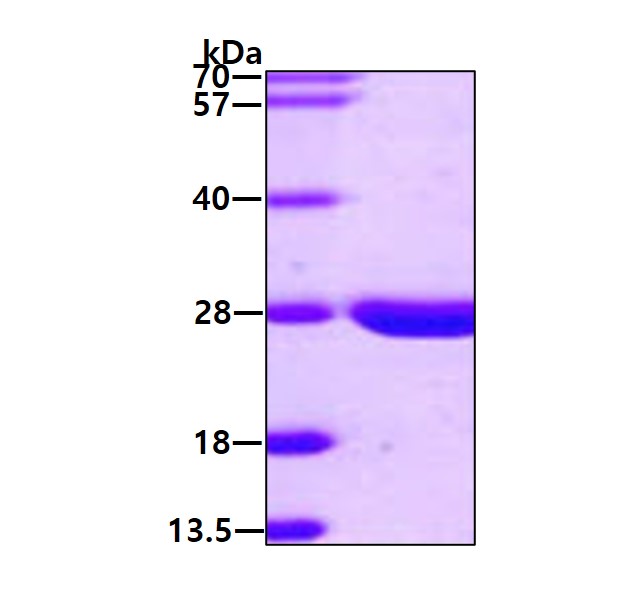

Human LYPLA2 protein (Recombinant) (His-Tag) (STJP017063)
SPECIFICATIONS
HostE.coli
ImmunogenHuman
General Information
| Short Description | Recombinant-Human LYPLA2-His-Tag protein was developed from e.coli and has a target region of His-Tag. For use in research applications. |
| Applications | SDS-PAGE |
| Host | E.coli |
| Note | STRICTLY FOR FURTHER SCIENTIFIC RESEARCH USE ONLY (RUO). MUST NOT TO BE USED IN DIAGNOSTIC OR THERAPEUTIC APPLICATIONS. |
Product Properties
| Concentration | 1 mg/mL |
| Formulation | Liquid in 20mM Tris-HCl buffer (pH 8.0) containing 1mM DTT, 10% Glycerol, 100mM NaCl |
| Storage Instruction | For short term storage, keep at +2C to +8C for up to 1 week. For long term storage, aliquot and store at-20C, and avoid repeat freeze-thaw cycles. |
Target Information
| Gene Symbol | LYPLA2 |
| Gene ID | 11313 |
| Uniprot ID | LYPA2_HUMAN |
| Accession Number | NP_009191.1 |
| Immunogen | Human |
| Immunogen Region | 1-231aa |
| Immunogen Sequence |
Additional Info
| Tissue Specificity | Expressed in various breast cancer cell lines. |
| Function | Acts as an acyl-protein thioesterase hydrolyzing fatty acids from S-acylated cysteine residues in proteins such as trimeric G alpha proteins, GSDMD, GAP43, ZDHHC6 or HRAS. Deacylates GAP43. Mediates depalmitoylation of ZDHHC6. Has lysophospholipase activity. Hydrolyzes prostaglandin glycerol esters (PG-Gs) in the following order prostaglandin D2-glycerol ester (PGD2-G) > prostaglandin E2 glycerol ester (PGE2-G) > prostaglandin F2-alpha-glycerol ester (PGF2-alpha-G). Hydrolyzes 1-arachidonoylglycerol but not 2-arachidonoylglycerol or arachidonoylethanolamide. |
| Protein Name | Acyl-Protein Thioesterase 2Apt-2Lysophospholipase IiLpl-IiLysopla IiPalmitoyl-Protein Hydrolase |
| Database Links | Reactome: R-HSA-373760 |
| Cellular Localisation | Cytoplasm |
| Alternative Protein Names | Acyl-Protein Thioesterase 2 proteinApt-2 proteinLysophospholipase Ii proteinLpl-Ii proteinLysopla Ii proteinPalmitoyl-Protein Hydrolase proteinLYPLA2 proteinAPT2 protein |
Information sourced from Uniprot.org