
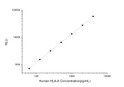


Human HLA-A (HLA class I histocompatibility antigen, A alpha chain) CLIA Kit for Quantitative Detection
SPECIFICATIONS
General Information
| Short Description | This human HLA-A kit is a highly sensitive in-vitro chemiluminescent immunoassay for the measurement of trace amounts of analytes in serum, plasma and other biological fluids. |
| Applications | CLIA |
| Reactivity | Human |
| Sensitivity | 37.5pg/mL |
| Detection Limit | 62.5~4000pg/mL |
| Note | FOR SCIENTIFIC EDUCATIONAL RESEARCH USE ONLY (RUO). MUST NOT BE USED IN DIAGNOSTIC OR OTHER MEDICAL APPLICATIONS. |
Product Properties
| Storage Instruction | If unopened the kit may be stored at 2-8°C for up to 1 month. If the kit will not be used within 1 month, store the components separately, according to the component table in the manual. |
| Assay Time | 3.5h |
| Detection | Chemiluminescence |
Target Information
| Gene Symbol | HLA-A |
| Gene ID | 3105 |
| Uniprot ID | HLAA_HUMAN |
| Specificity | This kit recognizes Human HLA-A in samples. No significant cross-reactivity or interference between Human HLA-A and analogues was observed. |
| Sample Type | Serum, plasma and other biological fluids |
Additional Info
| Tissue Specificity | Ubiquitous. |
| Post Translational Modifications | (Microbial infection) Polyubiquitinated in a post ER compartment by interaction with human herpesvirus 8 MIR1 protein. This targets the protein for rapid degradation via the ubiquitin system. N-linked glycosylation at Asn-110. |
| Function | Antigen-presenting major histocompatibility complex class I (MHCI) molecule. In complex with B2M/beta 2 microglobulin displays primarily viral and tumor-derived peptides on antigen-presenting cells for recognition by alpha-beta T cell receptor (TCR) on HLA-A-restricted CD8-positive T cells, guiding antigen-specific T cell immune response to eliminate infected or transformed cells. May also present self-peptides derived from the signal sequence of secreted or membrane proteins, although T cells specific for these peptides are usually inactivated to prevent autoreactivity. Both the peptide and the MHC molecule are recognized by TCR, the peptide is responsible for the fine specificity of antigen recognition and MHC residues account for the MHC restriction of T cells. Typically presents intracellular peptide antigens of 8 to 13 amino acids that arise from cytosolic proteolysis via IFNG-induced immunoproteasome or via endopeptidase IDE/insulin-degrading enzyme. Can bind different peptides containing allele-specific binding motifs, which are mainly defined by anchor residues at position 2 and 9. Allele A*01:01: Presents a restricted peptide repertoire including viral epitopes derived from IAV NP/nucleoprotein (CTELKLSDY), IAV PB1/polymerase basic protein 1 (VSDGGPNLY), HAdV-11 capsid L3/hexon protein (LTDLGQNLLY), SARS-CoV-2 3a/ORF3a (FTSDYYQLY) as well as tumor peptide antigens including MAGE1 (EADPTGHSY), MAGEA3 (EVDPIGHLY) and WT1 (TSEKRPFMCAY), all having in common a canonical motif with a negatively charged Asp or Glu residue at position 3 and a Tyr anchor residue at the C-terminus. A number of HLA-A*01:01-restricted peptides carry a post-translational modification with oxidation and N-terminal acetylation being the most frequent. Fails to present highly immunogenic peptides from the EBV latent antigens. Allele A*02:01: A major allele in human populations, presents immunodominant viral epitopes derived from IAV M/matrix protein 1 (GILGFVFTL), HIV-1 env (TLTSCNTSV), HIV-1 gag-pol (ILKEPVHGV), HTLV-1 Tax (LLFGYPVYV), HBV C/core antigen (FLPSDFFPS), HCMV UL83/pp65 (NLVPMVATV) as well as tumor peptide antigens including MAGEA4 (GVYDGREHTV), WT1 (RMFPNAPYL) and CTAG1A/NY-ESO-1 (SLLMWITQC), all having in common hydrophobic amino acids at position 2 and at the C-terminal anchors. Allele A*03:01: Presents viral epitopes derived from IAV NP (ILRGSVAHK), HIV-1 nef (QVPLRPMTYK), HIV-1 gag-pol (AIFQSSMTK), SARS-CoV-2 N/nucleoprotein (KTFPPTEPK) as well as tumor peptide antigens including PMEL (LIYRRRLMK), NODAL (HAYIQSLLK), TRP-2 (RMYNMVPFF), all having in common hydrophobic amino acids at position 2 and Lys or Arg anchor residues at the C-terminus. May also display spliced peptides resulting from the ligation of two separate proteasomal cleavage products that are not contiguous in the parental protein. Allele A*11:01: Presents several immunodominant epitopes derived from HIV-1 gag-pol and HHV-4 EBNA4, containing the peptide motif with Val, Ile, Thr, Leu, Tyr or Phe at position 2 and Lys anchor residue at the C-terminus. Important in the control of HIV-1, EBV and HBV infections. Presents an immunodominant epitope derived from SARS-CoV-2 N/nucleoprotein (KTFPPTEPK). Allele A*23:01: Interacts with natural killer (NK) cell receptor KIR3DL1 and may contribute to functional maturation of NK cells and self-nonself discrimination during innate immune response. Allele A*24:02: Presents viral epitopes derived from HIV-1 nef (RYPLTFGWCF), EBV lytic- and latent-cycle antigens BRLF1 (TYPVLEEMF), BMLF1 (DYNFVKQLF) and LMP2 (IYVLVMLVL), SARS-CoV nucleocapsid/N (QFKDNVILL), as well as tumor peptide antigens including PRAME (LYVDSLFFL), all sharing a common signature motif, namely an aromatic residue Tyr or Phe at position 2 and a nonhydrophobic anchor residue Phe, Leu or Iso at the C-terminus. Interacts with natural killer (NK) cell receptor KIR3DL1 and may contribute to functional maturation of NK cells and self-nonself discrimination during innate immune response. Allele A*26:01: Presents several epitopes derived from HIV-1 gag-pol (EVIPMFSAL, ETKLGKAGY) and env (LVSDGGPNLY), carrying as anchor residues preferentially Glu at position 1, Val or Thr at position 2 and Tyr at the C-terminus. Allele A*29:02: Presents peptides having a common motif, namely a Glu residue at position 2 and Tyr or Leu anchor residues at the C-terminus. Allele A*32:01: Interacts with natural killer (NK) cell receptor KIR3DL1 and may contribute to functional maturation of NK cells and self-nonself discrimination during innate immune response. Allele A*68:01: Presents viral epitopes derived from IAV NP (KTGGPIYKR) and HIV-1 tat (ITKGLGISYGR), having a common signature motif namely, Val or Thr at position 2 and positively charged residues Arg or Lys at the C-terminal anchor. Allele A*74:01: Presents immunodominant HIV-1 epitopes derived from gag-pol (GQMVHQAISPR, QIYPGIKVR) and rev (RQIHSISER), carrying an aliphatic residue at position 2 and Arg anchor residue at the C-terminus. May contribute to viral load control in chronic HIV-1 infection. |
| Protein Name | Hla Class I Histocompatibility Antigen - A Alpha ChainHuman Leukocyte Antigen AHla-A |
| Database Links | Reactome: R-HSA-1236974Reactome: R-HSA-1236977Reactome: R-HSA-164940Reactome: R-HSA-198933Reactome: R-HSA-877300Reactome: R-HSA-8866654Reactome: R-HSA-909733Reactome: R-HSA-9705671Reactome: R-HSA-983170 |
| Cellular Localisation | Cell MembraneSingle-Pass Type I Membrane ProteinEndoplasmic Reticulum Membrane |
| Alternative CLIA Names | Hla Class I Histocompatibility Antigen - A Alpha Chain CLIA kitHuman Leukocyte Antigen A CLIA kitHla-A CLIA kitHLA-A CLIA kitHLAA CLIA kit |
| Specificity | This kit recognizes Human HLA-A in samples. No significant cross-reactivity or interference between Human HLA-A and analogues was observed. |
| Reproducibility | Both intra-CV and inter-CV are |
Information sourced from Uniprot.org
| Item | Specifications | Storage |
|---|---|---|
| Micro CLIA Plate (Dismountable) | 96T: 8 wells ×12 strips strips | -20℃, 6 months |
| Reference Standard | 96T: 2 vials 48T: 1 vial | -20℃, 6 months |
| Concentrated Biotinylated Detection Ab (100×) | 96T: 1 vial, 120 μL 60 μL | -20℃, 6 months |
| Concentrated HRP Conjugate (100×) | 96T: 1 vial, 120 μL 60 μL | -20℃ (Protect from light), 6 months |
| Reference Standard & Sample Diluent | 1 vial, 20 mL | 2-8°C, 6 months |
| Biotinylated Detection Ab Diluent | 1 vial, 14 mL | 2-8°C, 6 months |
| HRP Conjugate Diluent | 1 vial, 14 mL | 2-8°C, 6 months |
| Concentrated Wash Buffer (25×) | 1 vial, 30 mL | 2-8°C, 6 months |
| Substrate Reagent A | 1 vial, 5 mL | 2-8℃ (Protect from light) |
| Substrate Reagent B | 1 vial, 5 mL | 2-8℃ (Protect from light) |
| Plate Sealer | 5 pieces | |
| Manual | 1 copy | |
| Certificate of Analysis | 1 copy |
| Sample Type | Range (%) | Average Recovery (%) |
|---|---|---|
| Serum(n=8) | 90-105 | 97 |
| EDTA plasma(n=8) | 100-116 | 106 |
| Cell culture media(n=8) | 85-100 | 92 |
| Intra-assay Precision | Intra-assay Precision | Intra-assay Precision | Inter-assay Precision | Inter-assay Precision | Inter-assay Precision | |
|---|---|---|---|---|---|---|
| Sample | 1.00 | 2.00 | 3.00 | 1.00 | 2.00 | 3.00 |
| n | 20.00 | 20.00 | 20.00 | 20.00 | 20.00 | 20.00 |
| Mean (pg/mL) | 185.01 | 435.08 | 1940.99 | 179.60 | 444.34 | 1834.06 |
| Standard deviation | 19.93 | 43.16 | 131.60 | 16.06 | 31.19 | 137.74 |
| CV (%) | 10.77 | 9.92 | 6.78 | 8.94 | 7.02 | 7.51 |