

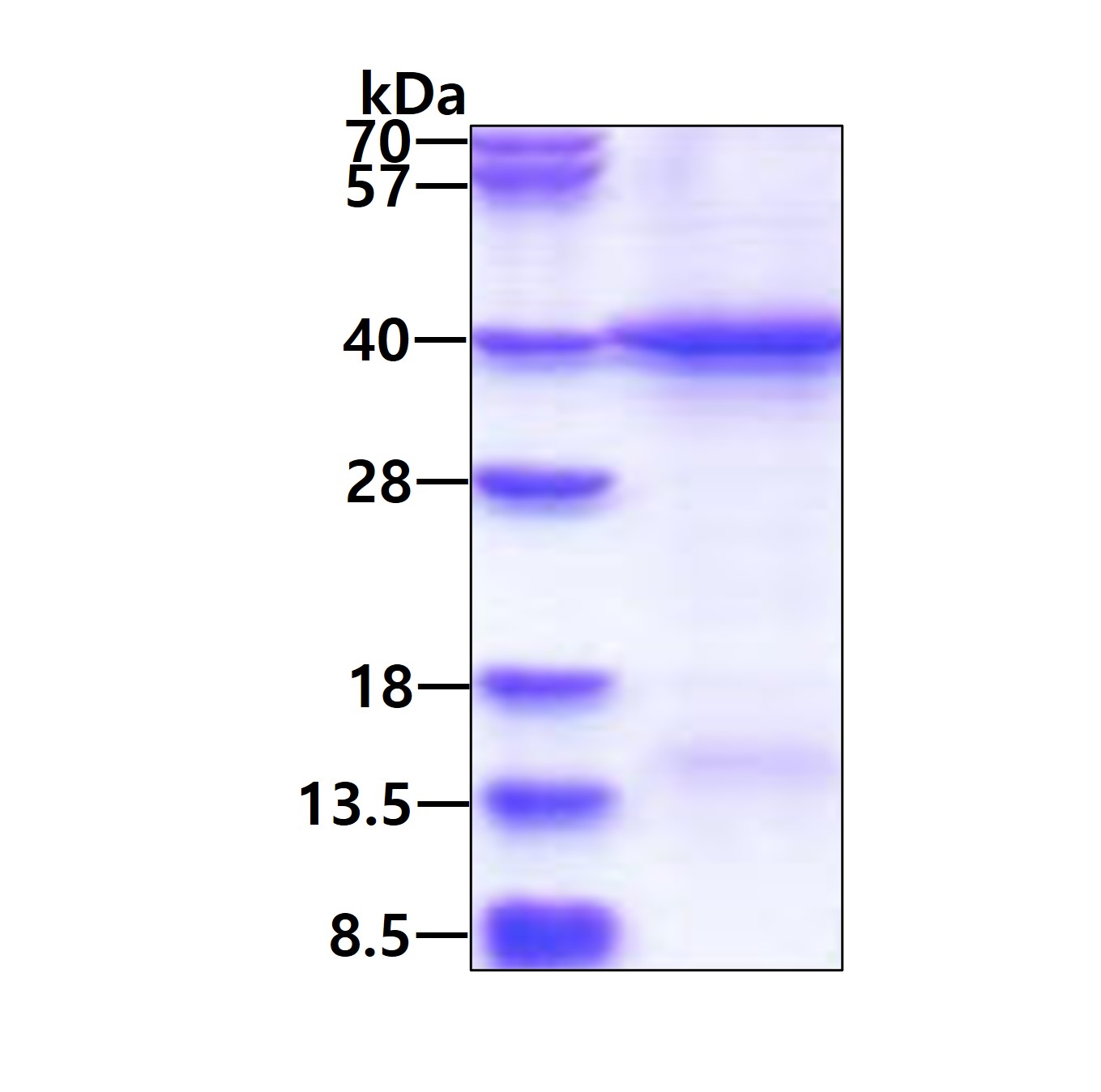

Human HERC5 protein (Recombinant) (His-Tag) (STJP018767)
SPECIFICATIONS
HostE.coli
ImmunogenHuman
General Information
| Short Description | Recombinant-Human HERC5-His-Tag protein was developed from e.coli and has a target region of His-Tag. For use in research applications. |
| Applications | SDS-PAGE/Denatured |
| Host | E.coli |
| Note | STRICTLY FOR FURTHER SCIENTIFIC RESEARCH USE ONLY (RUO). MUST NOT TO BE USED IN DIAGNOSTIC OR THERAPEUTIC APPLICATIONS. |
Product Properties
| Concentration | 1 mg/mL |
| Formulation | Liquid in 20mM Tris-HCl buffer (pH 8.0) containing 0.4M urea, 10% Glycerol |
| Storage Instruction | For short term storage, keep at +2C to +8C for up to 1 week. For long term storage, aliquot and store at-20C, and avoid repeat freeze-thaw cycles. |
Target Information
| Gene Symbol | HERC5 |
| Gene ID | 51191 |
| Uniprot ID | HERC5_HUMAN |
| Accession Number | NP_057407 |
| Immunogen | Human |
| Immunogen Region | 681-1024aa |
| Immunogen Sequence |
Additional Info
| Tissue Specificity | Expressed in testis and to a lesser degree in brain, ovary and placenta. Found in most tissues at low levels. |
| Post Translational Modifications | ISGylated. |
| Function | Major E3 ligase for ISG15 conjugation. Acts as a positive regulator of innate antiviral response in cells induced by interferon. Functions as part of the ISGylation machinery that recognizes target proteins in a broad and relatively non-specific manner. Catalyzes ISGylation of IRF3 which results in sustained activation, it attenuates IRF3-PIN1 interaction, which antagonizes IRF3 ubiquitination and degradation, and boosts the antiviral response. Mediates ISGylation of the phosphatase PTEN leading to its degradation, thus alleviating its suppression of the PI3K-AKT signaling pathway and promoting the production of cytokines that facilitate bacterial clearance. Interferes with the function of key viral structural proteins such as ebolavirus structural protein VP40 or HIV-1 protein GAG. Catalyzes ISGylation of influenza A viral NS1 which attenuates virulence.ISGylated NS1 fails to form homodimers and thus to interact with its RNA targets. Catalyzes ISGylation of papillomavirus type 16 L1 protein which results in dominant-negative effect on virus infectivity. Physically associated with polyribosomes, broadly modifies newly synthesized proteins in a cotranslational manner. In an interferon-stimulated cell, newly translated viral proteins are primary targets of ISG15. Promotes parkin/PRKN ubiquitin E3 ligase activity by suppressing the intramolecular interaction that maintains its autoinhibited conformation. (Microbial infection) Functions as an E3 ligase for ISGylation of hepatitis B virus protein X leading to enhanced viral replication due to increased interferon resistance. |
| Protein Name | E3 Isg15--Protein Ligase Herc5Cyclin-E-Binding Protein 1Hect Domain And Rcc1-Like Domain-Containing Protein 5 |
| Database Links | Reactome: R-HSA-1169408Reactome: R-HSA-168928Reactome: R-HSA-936440Reactome: R-HSA-983168Reactome: R-HSA-9833110Reactome: R-HSA-9833482Reactome: R-HSA-9909505 |
| Cellular Localisation | CytoplasmPerinuclear RegionAssociated With The PolyribosomesProbably Via The 60s Subunit |
| Alternative Protein Names | E3 Isg15--Protein Ligase Herc5 proteinCyclin-E-Binding Protein 1 proteinHect Domain And Rcc1-Like Domain-Containing Protein 5 proteinHERC5 proteinCEB1 proteinCEBP1 protein |
Information sourced from Uniprot.org