

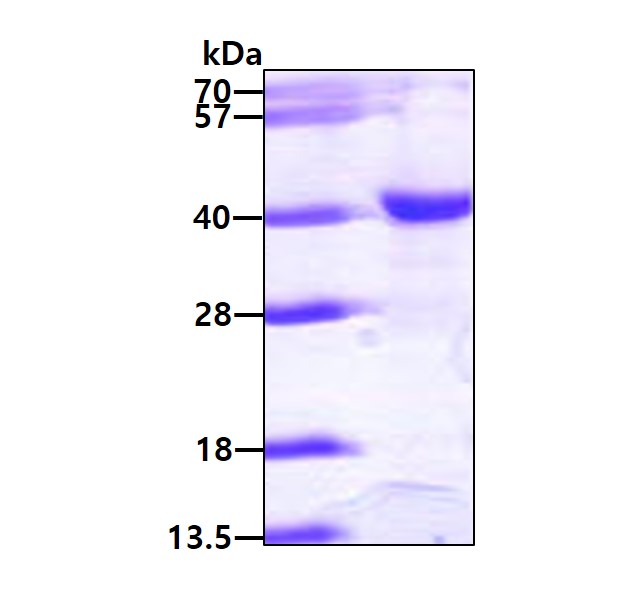

Human HAT1 protein (Recombinant) (His-Tag) (STJP016648)
SPECIFICATIONS
HostE.coli
ImmunogenHuman
General Information
| Short Description | Recombinant-Human HAT1-His-Tag protein was developed from e.coli and has a target region of His-Tag. For use in research applications. |
| Applications | SDS-PAGE |
| Host | E.coli |
| Note | STRICTLY FOR FURTHER SCIENTIFIC RESEARCH USE ONLY (RUO). MUST NOT TO BE USED IN DIAGNOSTIC OR THERAPEUTIC APPLICATIONS. |
Product Properties
| Concentration | 0.5 mg/mL |
| Formulation | Liquid in 20mM Tris-HCl buffer (pH 8.0) containing 10% Glycerol, 1mM DTT |
| Storage Instruction | For short term storage, keep at +2C to +8C for up to 1 week. For long term storage, aliquot and store at-20C, and avoid repeat freeze-thaw cycles. |
Target Information
| Gene Symbol | HAT1 |
| Gene ID | 8520 |
| Uniprot ID | HAT1_HUMAN |
| Accession Number | NP_003633 |
| Immunogen | Human |
| Immunogen Region | 20-341aa |
| Immunogen Sequence |
Additional Info
| Post Translational Modifications | Phosphorylated by AMPK at Ser-190.phosphorylation increases HAT1 activity. |
| Function | Histone acetyltransferase that plays a role in different biological processes including cell cycle progression, glucose metabolism, histone production or DNA damage repair. Coordinates histone production and acetylation via H4 promoter binding. Acetylates histone H4 at 'Lys-5' (H4K5ac) and 'Lys-12' (H4K12ac) and, to a lesser extent, histone H2A at 'Lys-5' (H2AK5ac). Drives H4 production by chromatin binding to support chromatin replication and acetylation. Since transcription of H4 genes is tightly coupled to S-phase, plays an important role in S-phase entry and progression. Promotes homologous recombination in DNA repair by facilitating histone turnover and incorporation of acetylated H3.3 at sites of double-strand breaks. In addition, acetylates other substrates such as chromatin-related proteins. Also acetylates RSAD2 which mediates the interaction of ubiquitin ligase UBE4A with RSAD2 leading to RSAD2 ubiquitination and subsequent degradation. (Microbial infection) Contributes to hepatitis B virus (HBV) replication by acetylating histone H4 at the sites of 'Lys-5' and 'Lys-12' on the covalently closed circular DNA (cccDNA) minichromosome leading to its accumulation within the host cell. |
| Protein Name | Histone Acetyltransferase Type B Catalytic SubunitHistone Acetyltransferase 1 |
| Database Links | Reactome: R-HSA-3214847 |
| Cellular Localisation | Isoform A: Nucleus MatrixMitochondrionIsoform B: CytoplasmNucleusNucleus MatrixNucleoplasmLocalization Is Predominantly Nuclear In Normal CellsTreatment With Hydrogen Peroxide Or Ionizing Radiation Enhances Nuclear Localization Through Redistribution Of Existing Protein |
| Alternative Protein Names | Histone Acetyltransferase Type B Catalytic Subunit proteinHistone Acetyltransferase 1 proteinHAT1 proteinKAT1 protein |
Information sourced from Uniprot.org