

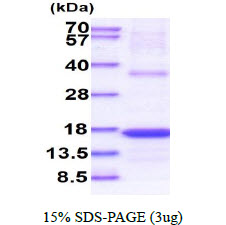

Human CD37 protein (Recombinant) (His-Tag) (STJP018974)
SPECIFICATIONS
HostE.coli
ImmunogenHuman
General Information
| Short Description | Recombinant-Human CD37-His-Tag protein was developed from e.coli and has a target region of His-Tag. For use in research applications. |
| Applications | SDS-PAGE/Denatured |
| Host | E.coli |
| Note | STRICTLY FOR FURTHER SCIENTIFIC RESEARCH USE ONLY (RUO). MUST NOT TO BE USED IN DIAGNOSTIC OR THERAPEUTIC APPLICATIONS. |
Product Properties
| Concentration | 1 mg/mL |
| Formulation | Liquid in phosphate-Buffered Saline (pH 7.4) containing 10% Glycerol |
| Storage Instruction | For short term storage, keep at +2C to +8C for up to 1 week. For long term storage, aliquot and store at-20C, and avoid repeat freeze-thaw cycles. |
Target Information
| Gene Symbol | CD37 |
| Gene ID | 951 |
| Uniprot ID | CD37_HUMAN |
| Accession Number | NP_001765 |
| Immunogen | Human |
| Immunogen Region | 112-241aa |
| Immunogen Sequence |
Additional Info
| Tissue Specificity | B-lymphocytes. Antigen presenting cells. |
| Post Translational Modifications | Tyrosine phosphorylated.leading to activation of downstream signaling pathways. |
| Function | Structural component of specialized membrane microdomains known as tetraspanin-enriched microdomains (TERMs), which act as platforms for receptor clustering and signaling. Participates thereby in diverse biological functions such as cell signal transduction, adhesion, migration and protein trafficking. Upon ligand binding, two signaling pathways are activated, one acting through phosphorylation by LYN leading to cell death or a survival pathway with activation of GSK3B. Plays an essential role essential for clustering of integrin ITGA4/ITGB1 and promotes its mobility in the plasma membrane of B-cells. In turn, participates in ITGA4/ITGB1 integrin-mediated antiapoptotic signaling through AKT. Also plays a role in the migration of dendritic cells and neutrophils to draining lymph nodes, as well as in their integrin-mediated adhesion. Negatively regulates IL-6 responses through direct interaction with SOCS3 thereby preventing constitutive IL-6 signaling. Alternatively, inhibition of IL-6 signaling can also occur via interaction and stabilization of DECTIN1/CLEC7A at the cell membrane to inhibit its ability to promote the production of IL-6. |
| Protein Name | Leukocyte Antigen Cd37Tetraspanin-26Tspan-26Cd Antigen Cd37 |
| Database Links | |
| Cellular Localisation | Cell MembraneMulti-Pass Membrane Protein |
| Alternative Protein Names | Leukocyte Antigen Cd37 proteinTetraspanin-26 proteinTspan-26 proteinCd Antigen Cd37 proteinCD37 proteinTSPAN26 protein |
Information sourced from Uniprot.org