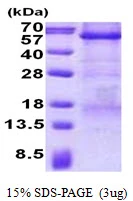
| Short Description : | Recombinant-Human Carboxypeptidase E-protein was developed from hek293. For use in research applications. |
| Host: | HEK293 |
| Note: | STRICTLY FOR FURTHER RESEARCH USE ONLY (RUO). MUST NOT TO BE USED IN DIAGNOSTIC OR THERAPEUTIC APPLICATIONS. |
| Conjugation: | Unconjugated |
| Formulation: | Lyophilised from 0.2 Mu m filtered PBS solution, pH7.2, 5% Trehalose. |
| Storage Instruction: | Can be stored in working aliquots at 2°C-8°C C for one month, or at-20°C to-70°C for 1 year. Avoid repeated freeze/thaw cycles. NA |
| Endotoxin: | Endotoxin content was assayed using a LAL gel clot method. Endotoxin level was found to be less than 0.1 ng/µg (1EU/µg). NA |
| Immunoreactivity: | The activity was tested by the ability to cleave a peptide substrate, benzoylAROH, and was measured to be 10 nMole/min/ug. NA |
| Gene Symbol: | CPE |
| Gene ID: | 1363 |
| Uniprot ID: | CBPE_HUMAN |
| Immunogen: | Optimized DNA sequence encoding peptidase domain of Human Carboxypeptidase E-CPE (GLU26-SER453 ) including a C-terminal His tag was expressed in HEK293 cells. NA |
| Immunogen Region: | GLU26-SER453 |
| Function | Sorting receptor that directs prohormones to the regulated secretory pathway. Also acts as a prohormone processing enzyme in neuro/endocrine cells, removing dibasic residues from the C-terminal end of peptide hormone precursors after initial endoprotease cleavage. |
| Protein Name | Carboxypeptidase ECpeCarboxypeptidase HCphEnkephalin ConvertaseProhormone-Processing Carboxypeptidase |
| Database Links | Reactome: R-HSA-264876 |
| Cellular Localisation | Isoform 1: Cytoplasmic VesicleSecretory VesicleCytoplasmic VesicleSecretory Vesicle MembranePeripheral Membrane ProteinSecretedAssociated With The Secretory Granule Membrane Through Direct Binding To Lipid Rafts In Intragranular Conditions |
| Alternative Protein Names | Carboxypeptidase E proteinCpe proteinCarboxypeptidase H proteinCph proteinEnkephalin Convertase proteinProhormone-Processing Carboxypeptidase proteinCPE protein |
Information sourced from Uniprot.org