
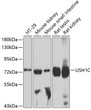


Anti-USH1C antibody (1-100) (STJ26052)
SPECIFICATIONS
ClonalityPolyclonal
HostRabbit
ConjugationUnconjugated
IsotypeIgG
General Information
| Short Description | Rabbit polyclonal USH1C (1-100) antibody for use in WB and ELISA in human, mouse and rat samples. Datasheet included with dilution recommendations, and related reagents. |
| Applications | WB/ELISA |
| Host | Rabbit |
| Reactivity | Human/Mouse/Rat |
| Note | STRICTLY FOR FURTHER SCIENTIFIC RESEARCH USE ONLY (RUO). MUST NOT TO BE USED IN DIAGNOSTIC OR THERAPEUTIC APPLICATIONS. |
Product Properties
| Clonality | Polyclonal |
| Isotype | IgG |
| Conjugation | Unconjugated |
| Concentration | Lot specific |
| Purification | Affinity purification |
| Dilution Range | WB:1:200-1:2000ELISA:Recommended starting concentration is 1 Mu g/mL. Please optimize the concentration based on your specific assay requirements. |
| Formulation | PBS with 0.02% Sodium Azide, 50% Glycerol, pH 7.3. |
| Storage Instruction | Store at-20°C for up to 1 year from the date of receipt, and avoid repeat freeze-thaw cycles. |
Target Information
| Immunogen Region | 1-100 |
| Immunogen Sequence | MERKVAREFRHKVELLIDNE AEKDYLYDVLRMYHQSMDLP VLVGDLKLVINEPKRLPLFD AIRPLIPLKHQVQYDQLTPK RSRKLKEVRLDRTHPEGLGL |
| Specificity | Recombinant fusion protein containing a sequence corresponding to amino acids 1-100 of zebrafish USH1C (NP_001035018.1). |
Additional Info
| Background | Predicted to enable actin filament binding activity. Acts upstream of or within neuron development; startle response; and synapse organization. Predicted to be part of stereocilia ankle link complex. Predicted to be active in several cellular components, including cilium; photoreceptor inner segment; and stereocilium tip. Is expressed in brain; hair cell; pleuroperitoneal region; sensory system; and trunk musculature. Used to study Usher syndrome. Human ortholog (s) of this gene implicated in Usher syndrome; Usher syndrome type 1; Usher syndrome type 1C; and autosomal recessive nonsyndromic deafness 18A. Orthologous to human USH1C (USH1 protein network component harmonin). |
Information sourced from Uniprot.org