


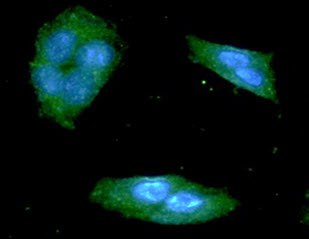
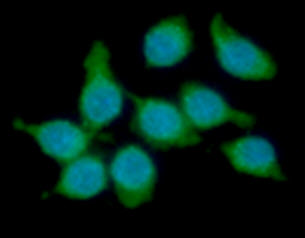
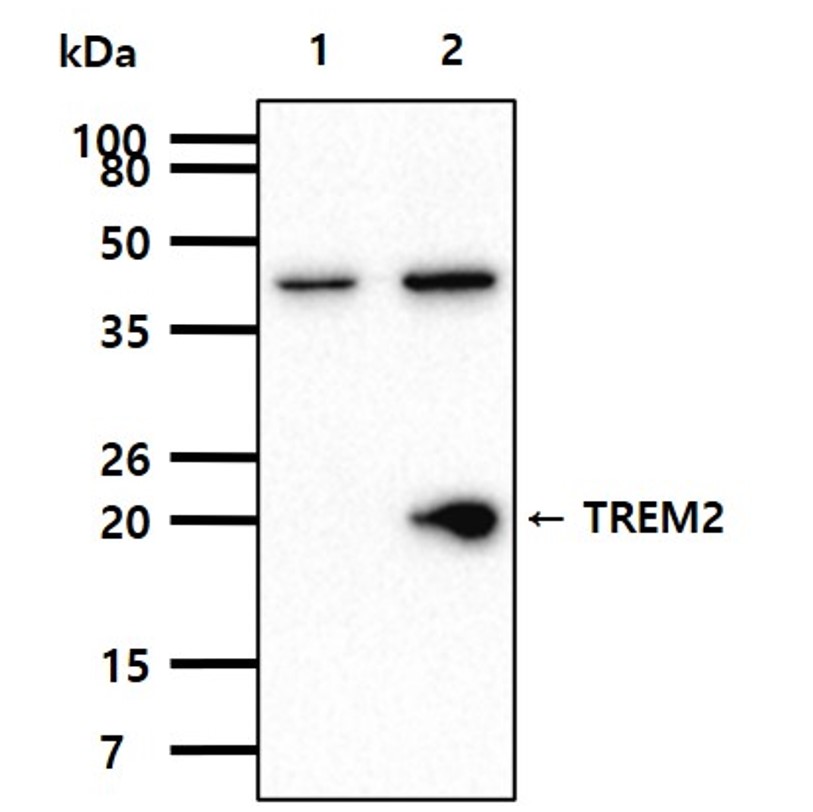
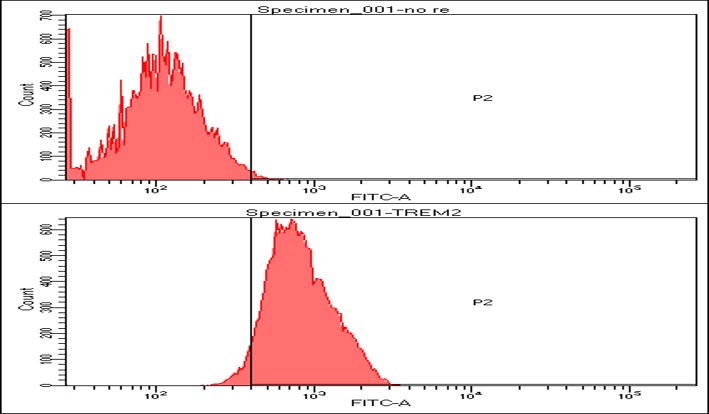

Anti-TREM2 antibody (19-161aa) [2B5] (STJA0041983)
SPECIFICATIONS
ClonalityMonoclonal
HostMouse
ConjugationUnconjugated
IsotypeIgG3k
ImmunogenRecombinant human TREM2 (19-161aa) purified from E. coli
General Information
| Short Description | Mouse monoclonal anti-TREM2 (19-161aa) for use in ELISA, WB, ICC, IF and FACS in Human samples. Datasheet included with dilution recommendations, and related reagents. |
| Applications | ELISA/WB/ICC/IF/FACS |
| Host | Mouse |
| Reactivity | Human |
| Note | STRICTLY FOR FURTHER SCIENTIFIC RESEARCH USE ONLY (RUO). MUST NOT TO BE USED IN DIAGNOSTIC OR THERAPEUTIC APPLICATIONS. |
Product Properties
| Clonality | Monoclonal |
| Clone ID | 2B5 |
| Isotype | IgG3k |
| Conjugation | Unconjugated |
| Concentration | 1 mg/mL |
| Purification | By protein-G affinity chromatography |
| Formulation | Liquid in phosphate-Buffered Saline (pH 7.4) with 0.02% Sodium Azide, 10% Glycerol |
| Storage Instruction | For short term storage, keep at +2C to +8C for up to 1 week. For long term storage, aliquot and store at-20C, and avoid repeat freeze-thaw cycles. |
Target Information
| Gene Symbol | TREM2 |
| Gene ID | 54209 |
| Uniprot ID | TREM2_HUMAN |
| Accession Number | NP_061838 |
| Immunogen | Recombinant human TREM2 (19-161aa) purified from E. coli |
| Immunogen Region | 19-161aa |
Additional Info
| Tissue Specificity | Expressed in the brain, specifically in microglia and in the fusiform gyrus (at protein level). Expressed on macrophages and dendritic cells but not on granulocytes or monocytes. In the CNS strongest expression seen in the basal ganglia, corpus callosum, medulla oblongata and spinal cord. |
| Post Translational Modifications | Undergoes ectodomain shedding through proteolytic cleavage by ADAM10 and ADAM17 to produce a transmembrane segment, the TREM2 C-terminal fragment (TREM2-CTF), which is subsequently cleaved by gamma-secretase. |
| Function | Forms a receptor signaling complex with TYROBP which mediates signaling and cell activation following ligand binding. Acts as a receptor for amyloid-beta protein 42, a cleavage product of the amyloid-beta precursor protein APP, and mediates its uptake and degradation by microglia. Binding to amyloid-beta 42 mediates microglial activation, proliferation, migration, apoptosis and expression of pro-inflammatory cytokines, such as IL6R and CCL3, and the anti-inflammatory cytokine ARG1. Acts as a receptor for lipoprotein particles such as LDL, VLDL, and HDL and for apolipoproteins such as APOA1, APOA2, APOB, APOE, APOE2, APOE3, APOE4, and CLU and enhances their uptake in microglia. Binds phospholipids (preferably anionic lipids) such as phosphatidylserine, phosphatidylethanolamine, phosphatidylglycerol and sphingomyelin. Regulates microglial proliferation by acting as an upstream regulator of the Wnt/beta-catenin signaling cascade. Required for microglial phagocytosis of apoptotic neurons. Also required for microglial activation and phagocytosis of myelin debris after neuronal injury and of neuronal synapses during synapse elimination in the developing brain. Regulates microglial chemotaxis and process outgrowth, and also the microglial response to oxidative stress and lipopolysaccharide. It suppresses PI3K and NF-kappa-B signaling in response to lipopolysaccharide.thus promoting phagocytosis, suppressing pro-inflammatory cytokine and nitric oxide production, inhibiting apoptosis and increasing expression of IL10 and TGFB. During oxidative stress, it promotes anti-apoptotic NF-kappa-B signaling and ERK signaling. Plays a role in microglial MTOR activation and metabolism. Regulates age-related changes in microglial numbers. Triggers activation of the immune responses in macrophages and dendritic cells. Mediates cytokine-induced formation of multinucleated giant cells which are formed by the fusion of macrophages. In dendritic cells, receptor of SEMA6D with PLEXNA1 as coreceptor and mediates up-regulation of chemokine receptor CCR7 and dendritic cell maturation and survival. Involved in the positive regulation of osteoclast differentiation. |
| Protein Name | Triggering Receptor Expressed On Myeloid Cells 2Trem-2Triggering Receptor Expressed On Monocytes 2 |
| Database Links | Reactome: R-HSA-198933Reactome: R-HSA-2172127Reactome: R-HSA-2424491Reactome: R-HSA-416700 |
| Cellular Localisation | Isoform 1: Cell MembraneSingle-Pass Type I Membrane ProteinIsoform 2: SecretedIsoform 3: Secreted |
| Alternative Antibody Names | Anti-Triggering Receptor Expressed On Myeloid Cells 2 antibodyAnti-Trem-2 antibodyAnti-Triggering Receptor Expressed On Monocytes 2 antibodyAnti-TREM2 antibody |
Information sourced from Uniprot.org