


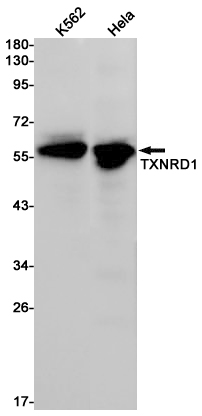

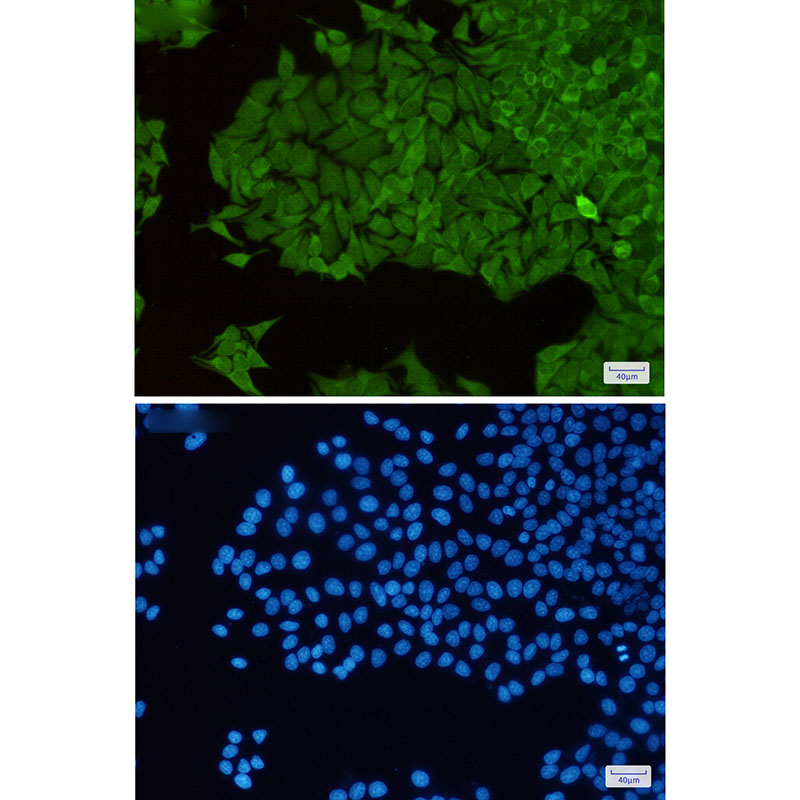

Anti-Thioredoxin Reductase 1 antibody [R01-8I4] (STJA0034967)
SPECIFICATIONS
ClonalityMonoclonal
HostRabbit
ConjugationUnconjugated
IsotypeIgG
ImmunogenRecombinant protein of human TXNRD1
General Information
| Short Description | Rabbit monoclonal anti-Thioredoxin Reductase 1 for use in WB, IHC-F, IHC-P, ICC, IF and IP in Human and Mouse samples. Datasheet included with dilution recommendations, and related reagents. |
| Applications | WB/IHC-F/IHC-P/ICC/IF/IP |
| Host | Rabbit |
| Reactivity | Human/Mouse |
| Note | STRICTLY FOR FURTHER SCIENTIFIC RESEARCH USE ONLY (RUO). MUST NOT TO BE USED IN DIAGNOSTIC OR THERAPEUTIC APPLICATIONS. |
Product Properties
| Clonality | Monoclonal |
| Clone ID | R01-8I4 |
| Isotype | IgG |
| Conjugation | Unconjugated |
| Concentration | 0.3 mg/mL |
| Purification | Affinity Purified |
| Dilution Range | WB 1:500-1:1000IHC 1:50-1:100IF 1:50-1:200IP 1:20 |
| Formulation | 50mM Tris-Glycine (pH 7.4) , 0.15M NaCl, 40% Glycerol, 0.01% Sodium azide and 0.05% BSA |
| Storage Instruction | Store at 4°C short term. Aliquot and store at-20°C long term. Avoid freeze/thaw cycles. |
Target Information
| Gene Symbol | TXNRD1 |
| Gene ID | 7296 |
| Uniprot ID | TRXR1_HUMAN |
| Immunogen | Recombinant protein of human TXNRD1 |
Additional Info
| Tissue Specificity | Isoform 1: Expressed predominantly in Leydig cells (at protein level). Also expressed in ovary, spleen, heart, liver, kidney and pancreas and in a number of cancer cell lines. Isoform 4: Widely expressed with highest levels in kidney, testis, uterus, ovary, prostate, placenta and fetal liver. |
| Post Translational Modifications | Isoform 5: The N-terminus is blocked. ISGylated. |
| Function | Reduces disulfideprotein thioredoxin (Trx) to its dithiol-containing form. Homodimeric flavoprotein involved in the regulation of cellular redox reactions, growth and differentiation. Contains a selenocysteine residue at the C-terminal active site that is essential for catalysis (Probable). Also has reductase activity on hydrogen peroxide (H2O2). Isoform 1: Induces actin and tubulin polymerization, leading to formation of cell membrane protrusions. Isoform 4: Enhances the transcriptional activity of estrogen receptors ESR1 and ESR2. Isoform 5: Enhances the transcriptional activity of the estrogen receptor ESR2 only. Mediates cell death induced by a combination of interferon-beta and retinoic acid. |
| Protein Name | Thioredoxin Reductase 1 - CytoplasmicTrGene Associated With Retinoic And Interferon-Induced Mortality 12 ProteinGrim-12Gene Associated With Retinoic And Ifn-Induced Mortality 12 ProteinKm-102-Derived Reductase-Like FactorPeroxidase Txnrd1Thioredoxin Reductase Tr1 |
| Database Links | Reactome: R-HSA-1989781Reactome: R-HSA-2408550Reactome: R-HSA-3299685Reactome: R-HSA-499943Reactome: R-HSA-5263617Reactome: R-HSA-5336415Reactome: R-HSA-5628897Reactome: R-HSA-9818027 |
| Cellular Localisation | Isoform 1: CytoplasmIsoform 4: CytoplasmNucleusIsoform 5: Cytoplasm |
| Alternative Antibody Names | Anti-Thioredoxin Reductase 1 - Cytoplasmic antibodyAnti-Tr antibodyAnti-Gene Associated With Retinoic And Interferon-Induced Mortality 12 Protein antibodyAnti-Grim-12 antibodyAnti-Gene Associated With Retinoic And Ifn-Induced Mortality 12 Protein antibodyAnti-Km-102-Derived Reductase-Like Factor antibodyAnti-Peroxidase Txnrd1 antibodyAnti-Thioredoxin Reductase Tr1 antibodyAnti-TXNRD1 antibodyAnti-GRIM12 antibodyAnti-KDRF antibody |
Information sourced from Uniprot.org