


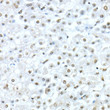

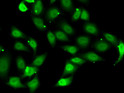


Anti-TEAD1 antibody (135-215) (STJ28851)
SPECIFICATIONS
ClonalityPolyclonal
HostRabbit
ConjugationUnconjugated
IsotypeIgG
General Information
| Short Description | Rabbit polyclonal TEAD1 (135-215) antibody for use in WB, IHC-P, IF, ICC, IP, ELISA and ChIP in human, mouse and rat samples. Datasheet included with dilution recommendations, and related reagents. |
| Applications | WB/IHC-P/IF/ICC/IP/ELISA/ChIP |
| Host | Rabbit |
| Reactivity | Human/Mouse/Rat |
| Note | STRICTLY FOR FURTHER SCIENTIFIC RESEARCH USE ONLY (RUO). MUST NOT TO BE USED IN DIAGNOSTIC OR THERAPEUTIC APPLICATIONS. |
Product Properties
| Clonality | Polyclonal |
| Isotype | IgG |
| Conjugation | Unconjugated |
| Concentration | Lot specific |
| Purification | Affinity purification |
| Dilution Range | WB:1:1000-1:5000IHC-P:1:50-1:200IF/ICC:1:50-1:200IP:0.5 Mu g-4 Mu g antibody for 400 Mu g-600 Mu g extracts of whole cellsELISA:Recommended starting concentration is 1 Mu g/mL. Please optimize the concentration based on your speci |
| Formulation | PBS with 0.05% Proclin300, 50% Glycerol, pH 7.3. |
| Storage Instruction | Store at-20°C for up to 1 year from the date of receipt, and avoid repeat freeze-thaw cycles. |
Target Information
| Gene Symbol | TEAD1 |
| Gene ID | 7003 |
| Uniprot ID | TEAD1_HUMAN |
| Immunogen Region | 135-215 |
| Immunogen Sequence | AIHNKLGLPGIPRPTFPGAP GFWPGMIQTGQPGSSQDVKP FVQQAYPIQPAVTAPIPGFE PASAPAPSVPAWQGRSIGTT K |
| Specificity | Recombinant fusion protein containing a sequence corresponding to amino acids 135-215 of human TEAD1 (NP_068780.2). |
Additional Info
| Tissue Specificity | Preferentially expressed in skeletal muscle. Lower levels in pancreas, placenta, and heart. |
| Post Translational Modifications | Lactylation by AARS1 promotes nuclear localization and stabilization of YAP1, leading to increased Hippo signaling pathway. Delactylated by SIRT1. |
| Function | Transcription factor which plays a key role in the Hippo signaling pathway, a pathway involved in organ size control and tumor suppression by restricting proliferation and promoting apoptosis. The core of this pathway is composed of a kinase cascade wherein MST1/MST2, in complex with its regulatory protein SAV1, phosphorylates and activates LATS1/2 in complex with its regulatory protein MOB1, which in turn phosphorylates and inactivates YAP1 oncoprotein and WWTR1/TAZ. Acts by mediating gene expression of YAP1 and WWTR1/TAZ, thereby regulating cell proliferation, migration and epithelial mesenchymal transition (EMT) induction. Binds specifically and cooperatively to the SPH and GT-IIC 'enhansons' (5'-GTGGAATGT-3') and activates transcription in vivo in a cell-specific manner. The activation function appears to be mediated by a limiting cell-specific transcriptional intermediary factor (TIF). Involved in cardiac development. Binds to the M-CAT motif. |
| Protein Name | Transcriptional Enhancer Factor Tef-1Ntef-1Protein Gt-IicTea Domain Family Member 1Tead-1Transcription Factor 13Tcf-13 |
| Database Links | Reactome: R-HSA-2032785Reactome: R-HSA-8951671Reactome: R-HSA-9619665 |
| Cellular Localisation | Nucleus |
| Alternative Antibody Names | Anti-Transcriptional Enhancer Factor Tef-1 antibodyAnti-Ntef-1 antibodyAnti-Protein Gt-Iic antibodyAnti-Tea Domain Family Member 1 antibodyAnti-Tead-1 antibodyAnti-Transcription Factor 13 antibodyAnti-Tcf-13 antibodyAnti-TEAD1 antibodyAnti-TCF13 antibodyAnti-TEF1 antibody |
Information sourced from Uniprot.org