

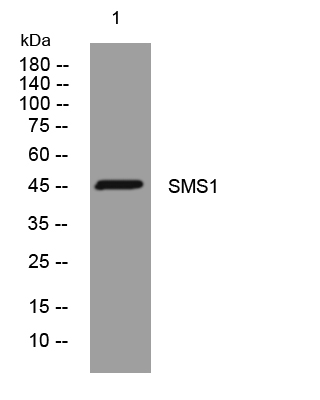
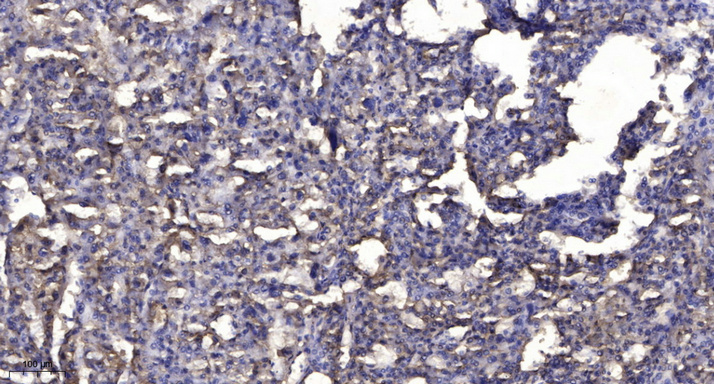

Anti-SGMS1 antibody (156-206 aa) (STJ195230)
SPECIFICATIONS
ClonalityPolyclonal
HostRabbit
ConjugationUnconjugated
IsotypeIgG
ImmunogenSynthesized peptide derived from the human SMS1 at the amino acid range 156-206
General Information
| Short Description | Rabbit polyclonal anti-Phosphatidylcholine:ceramide cholinephosphotransferase 1 (156-206 aa) for use in WB, ELISA and IHC in Human, Mouse and Rat samples. Datasheet included with dilution recommendations, and related reagents. |
| Applications | WB/ELISA/IHC |
| Host | Rabbit |
| Reactivity | Human/Mouse/Rat |
| Note | STRICTLY FOR FURTHER SCIENTIFIC RESEARCH USE ONLY (RUO). MUST NOT TO BE USED IN DIAGNOSTIC OR THERAPEUTIC APPLICATIONS. |
Product Properties
| Clonality | Polyclonal |
| Isotype | IgG |
| Conjugation | Unconjugated |
| Concentration | 1 mg/mL |
| Purification | The antibody was affinity-purified from rabbit antiserum by affinity-chromatography using epitope-specific immunogen. |
| Dilution Range | WB 1:500-2000IHC-P 1:50-300ELISA 2000-20000 |
| Formulation | Liquid in PBS containing 50% Glycerol, 0.5% BSA and 0.02% Sodium Azide. |
| Storage Instruction | Store at-20°C for up to 1 year from the date of receipt, and avoid repeat freeze-thaw cycles. |
Target Information
| Gene Symbol | SGMS1 |
| Gene ID | 259230 |
| Uniprot ID | SMS1_HUMAN |
| Immunogen | Synthesized peptide derived from the human SMS1 at the amino acid range 156-206 |
| Immunogen Region | 156-206 aa |
| Specificity | This antibody detects endogenous levels of SMS1 at Human/Mouse/Rat |
Additional Info
| Function | Major sphingomyelin synthase at the Golgi apparatus. Catalyzes the reversible transfer of phosphocholine moiety in sphingomyelin biosynthesis: in the forward reaction transfers phosphocholine head group of phosphatidylcholine (PC) on to ceramide (CER) to form ceramide phosphocholine (sphingomyelin, SM) and diacylglycerol (DAG) as by-product, and in the reverse reaction transfers phosphocholine from SM to DAG to form PC and CER. The direction of the reaction depends on the levels of CER and DAG in Golgi membranes. Converts the newly synthesized CER, that is transported from the endoplasmic reticulum to the trans-Golgi by the Cer transport protein (CERT), to SM. Can form a heteromeric complex with glucosylceramide synthase (GCS) increasing SMS activity and reducing glucosylceramide synthesis, a critical mechanism that controls the metabolic fate of CER in the Golgi. Does not use free phosphorylcholine or CDP-choline as donor. Can also transfer phosphoethanolamine head group of phosphatidylethanolamine (PE) on to CER to form ceramide phosphoethanolamine (CPE). Regulates receptor-mediated signal transduction via mitogenic DAG and proapoptotic CER, as well as via SM, a structural component of membrane rafts that serve as platforms for signal transduction and protein sorting. Plays a role in secretory transport via regulation of DAG pool at the Golgi apparatus and its downstream effects on PRKD1. |
| Protein Name | Phosphatidylcholine -Ceramide Cholinephosphotransferase 1Medulla Oblongata-Derived ProteinProtein MobSphingomyelin Synthase 1Transmembrane Protein 23 |
| Database Links | Reactome: R-HSA-1660661 |
| Cellular Localisation | Golgi Apparatus MembraneMulti-Pass Membrane Protein |
| Alternative Antibody Names | Anti-Phosphatidylcholine -Ceramide Cholinephosphotransferase 1 antibodyAnti-Medulla Oblongata-Derived Protein antibodyAnti-Protein Mob antibodyAnti-Sphingomyelin Synthase 1 antibodyAnti-Transmembrane Protein 23 antibodyAnti-SGMS1 antibodyAnti-MOB antibodyAnti-SMS1 antibodyAnti-TMEM23 antibody |
Information sourced from Uniprot.org