

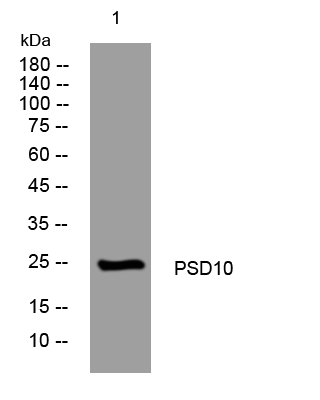
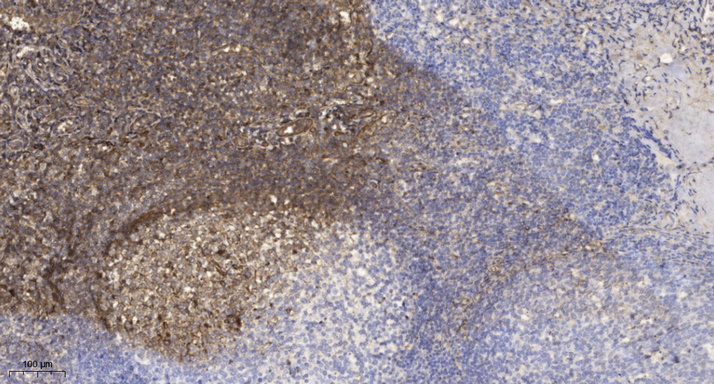

Anti-PSMD10 antibody (86-136 aa) (STJ195416)
SPECIFICATIONS
ClonalityPolyclonal
HostRabbit
ConjugationUnconjugated
IsotypeIgG
ImmunogenSynthesized peptide derived from the human PSD10 at the amino acid range 86-136
General Information
| Short Description | Rabbit polyclonal anti-26S proteasome non-ATPase regulatory subunit 10 (86-136 aa) for use in WB, ELISA and IHC in Human, Mouse and Rat samples. Datasheet included with dilution recommendations, and related reagents. |
| Applications | WB/ELISA/IHC |
| Host | Rabbit |
| Reactivity | Human/Mouse/Rat |
| Note | STRICTLY FOR FURTHER SCIENTIFIC RESEARCH USE ONLY (RUO). MUST NOT TO BE USED IN DIAGNOSTIC OR THERAPEUTIC APPLICATIONS. |
Product Properties
| Clonality | Polyclonal |
| Isotype | IgG |
| Conjugation | Unconjugated |
| Concentration | 1 mg/mL |
| Purification | The antibody was affinity-purified from rabbit antiserum by affinity-chromatography using epitope-specific immunogen. |
| Dilution Range | WB 1:500-2000IHC-P 1:50-300ELISA 2000-20000 |
| Formulation | Liquid in PBS containing 50% Glycerol, 0.5% BSA and 0.02% Sodium Azide. |
| Storage Instruction | Store at-20°C for up to 1 year from the date of receipt, and avoid repeat freeze-thaw cycles. |
Target Information
| Gene Symbol | PSMD10 |
| Gene ID | 5716 |
| Uniprot ID | PSD10_HUMAN |
| Immunogen | Synthesized peptide derived from the human PSD10 at the amino acid range 86-136 |
| Immunogen Region | 86-136 aa |
| Specificity | This antibody detects endogenous levels of PSD10 at Human/Mouse/Rat |
Additional Info
| Function | Acts as a chaperone during the assembly of the 26S proteasome, specifically of the PA700/19S regulatory complex (RC). In the initial step of the base subcomplex assembly is part of an intermediate PSMD10:PSMC4:PSMC5:PAAF1 module which probably assembles with a PSMD5:PSMC2:PSMC1:PSMD2 module. Independently of the proteasome, regulates EGF-induced AKT activation through inhibition of the RHOA/ROCK/PTEN pathway, leading to prolonged AKT activation. Plays an important role in RAS-induced tumorigenesis. Acts as an proto-oncoprotein by being involved in negative regulation of tumor suppressors RB1 and p53/TP53. Overexpression is leading to phosphorylation of RB1 and proteasomal degradation of RB1. Regulates CDK4-mediated phosphorylation of RB1 by competing with CDKN2A for binding with CDK4. Facilitates binding of MDM2 to p53/TP53 and the mono- and polyubiquitination of p53/TP53 by MDM2 suggesting a function in targeting the TP53:MDM2 complex to the 26S proteasome. Involved in p53-independent apoptosis. Involved in regulation of NF-kappa-B by retaining it in the cytoplasm. Binds to the NF-kappa-B component RELA and accelerates its XPO1/CRM1-mediated nuclear export. |
| Protein Name | 26s Proteasome Non-Atpase Regulatory Subunit 1026s Proteasome Regulatory Subunit P28GankyrinP28(Gank |
| Database Links | Reactome: R-HSA-9907900 |
| Cellular Localisation | CytoplasmNucleus |
| Alternative Antibody Names | Anti-26s Proteasome Non-Atpase Regulatory Subunit 10 antibodyAnti-26s Proteasome Regulatory Subunit P28 antibodyAnti-Gankyrin antibodyAnti-P28(Gank antibodyAnti-PSMD10 antibody |
Information sourced from Uniprot.org