


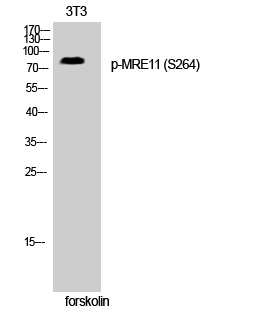
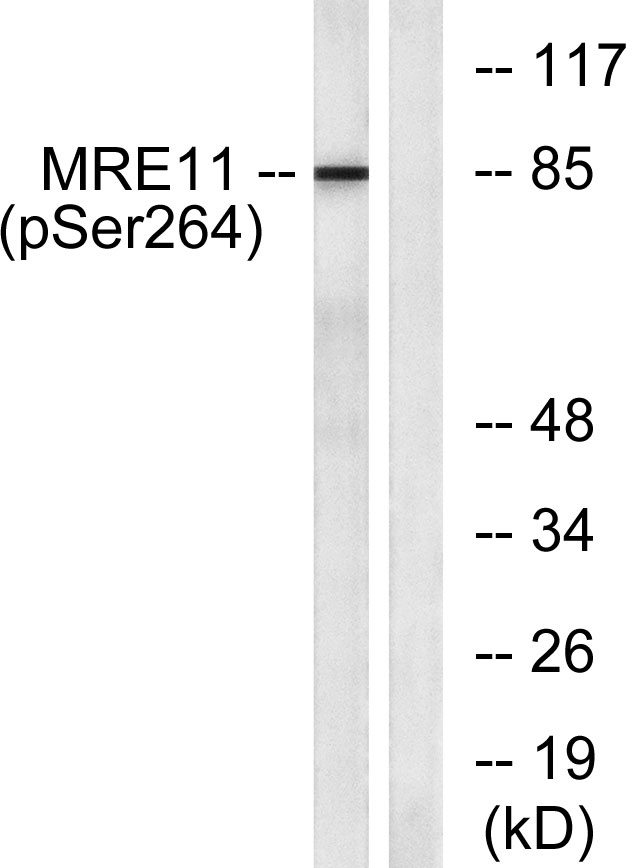
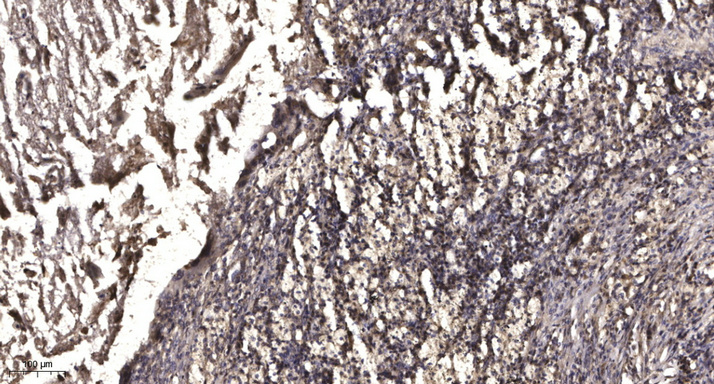

Anti-Phospho-MRE11-Ser264 antibody (230-279 aa) (STJ90554)
SPECIFICATIONS
ClonalityPolyclonal
HostRabbit
ConjugationUnconjugated
IsotypeIgG
ImmunogenThe antiserum was produced against synthesized peptide derived from the human MRE11 around the phosphorylation site of Ser264 at the amino acid range 230-279
General Information
| Short Description | Rabbit polyclonal anti-Phospho-Double-strand break repair protein MRE11-Ser264 (230-279 aa) for use in WB, ELISA and IHC in Human, Mouse and Rat samples. Datasheet included with dilution recommendations, and related reagents. |
| Applications | WB/ELISA/IHC |
| Host | Rabbit |
| Reactivity | Human/Mouse/Rat |
| Note | STRICTLY FOR FURTHER SCIENTIFIC RESEARCH USE ONLY (RUO). MUST NOT TO BE USED IN DIAGNOSTIC OR THERAPEUTIC APPLICATIONS. |
Product Properties
| Clonality | Polyclonal |
| Isotype | IgG |
| Conjugation | Unconjugated |
| Concentration | 1 mg/mL |
| Purification | The antibody was affinity-purified from rabbit antiserum by affinity-chromatography using epitope-specific immunogen. |
| Dilution Range | WB 1:500-2000IHC-P 1:50-300ELISA 2000-20000 |
| Formulation | Liquid in PBS containing 50% Glycerol, 0.5% BSA and 0.02% Sodium Azide. |
| Storage Instruction | Store at-20°C for up to 1 year from the date of receipt, and avoid repeat freeze-thaw cycles. |
Target Information
| Gene Symbol | MRE11 |
| Gene ID | 4361 |
| Uniprot ID | MRE11_HUMAN |
| Immunogen | The antiserum was produced against synthesized peptide derived from the human MRE11 around the phosphorylation site of Ser264 at the amino acid range 230-279 |
| Immunogen Region | 230-279 aa |
| Specificity | Phospho-MRE11 (S264) Polyclonal Antibody detects endogenous levels of MRE11 protein only when phosphorylated at S264. |
Additional Info
| Function | Core component of the MRN complex, which plays a central role in double-strand break (DSB) repair, DNA recombination, maintenance of telomere integrity and meiosis. The MRN complex is involved in the repair of DNA double-strand breaks (DSBs) via homologous recombination (HR), an error-free mechanism which primarily occurs during S and G2 phases. The complex (1) mediates the end resection of damaged DNA, which generates proper single-stranded DNA, a key initial steps in HR, and is (2) required for the recruitment of other repair factors and efficient activation of ATM and ATR upon DNA damage. Within the MRN complex, MRE11 possesses both single-strand endonuclease activity and double-strand-specific 3'-5' exonuclease activity. After DSBs, MRE11 is loaded onto DSBs sites and cleaves DNA by cooperating with RBBP8/CtIP to initiate end resection. MRE11 first endonucleolytically cleaves the 5' strand at DNA DSB ends to prevent non-homologous end joining (NHEJ) and licence HR. It then generates a single-stranded DNA gap via 3' to 5' exonucleolytic degradation to create entry sites for EXO1- and DNA2-mediated 5' to 3' long-range resection, which is required for single-strand invasion and recombination. RBBP8/CtIP specifically promotes the endonuclease activity of MRE11 to clear protein-DNA adducts and generate clean double-strand break ends. MRE11 endonuclease activity is also enhanced by AGER/RAGE. The MRN complex is also required for DNA damage signaling via activation of the ATM and ATR kinases: the nuclease activity of MRE11 is not required to activate ATM and ATR. The MRN complex is also required for the processing of R-loops. The MRN complex is involved in the activation of the cGAS-STING pathway induced by DNA damage during tumorigenesis: the MRN complex acts by displacing CGAS from nucleosome sequestration, thereby activating it. In telomeres the MRN complex may modulate t-loop formation. MRE11 contains two DNA-binding domains (DBDs), enabling it to bind both single-stranded DNA (ssDNA) and double-stranded DNA (dsDNA). |
| Protein Name | Double-Strand Break Repair Protein Mre11Meiotic Recombination 11 Homolog 1Mre11 Homolog 1Meiotic Recombination 11 Homolog AMre11 Homolog A |
| Database Links | Reactome: R-HSA-1834949Reactome: R-HSA-2559586Reactome: R-HSA-3270619Reactome: R-HSA-5685938Reactome: R-HSA-5685939Reactome: R-HSA-5685942Reactome: R-HSA-5693548Reactome: R-HSA-5693554Reactome: R-HSA-5693565Reactome: R-HSA-5693568Reactome: R-HSA-5693571Reactome: R-HSA-5693579Reactome: R-HSA-5693607Reactome: R-HSA-5693616Reactome: R-HSA-6804756Reactome: R-HSA-69473Reactome: R-HSA-912446Reactome: R-HSA-9701192Reactome: R-HSA-9704331Reactome: R-HSA-9704646Reactome: R-HSA-9709570Reactome: R-HSA-9709603 |
| Cellular Localisation | NucleusChromosomeTelomereLocalizes To Dna Double-Strand Breaks (Dsbs) |
| Alternative Antibody Names | Anti-Double-Strand Break Repair Protein Mre11 antibodyAnti-Meiotic Recombination 11 Homolog 1 antibodyAnti-Mre11 Homolog 1 antibodyAnti-Meiotic Recombination 11 Homolog A antibodyAnti-Mre11 Homolog A antibodyAnti-MRE11 antibodyAnti-HNGS1 antibodyAnti-MRE11A antibody |
Information sourced from Uniprot.org