
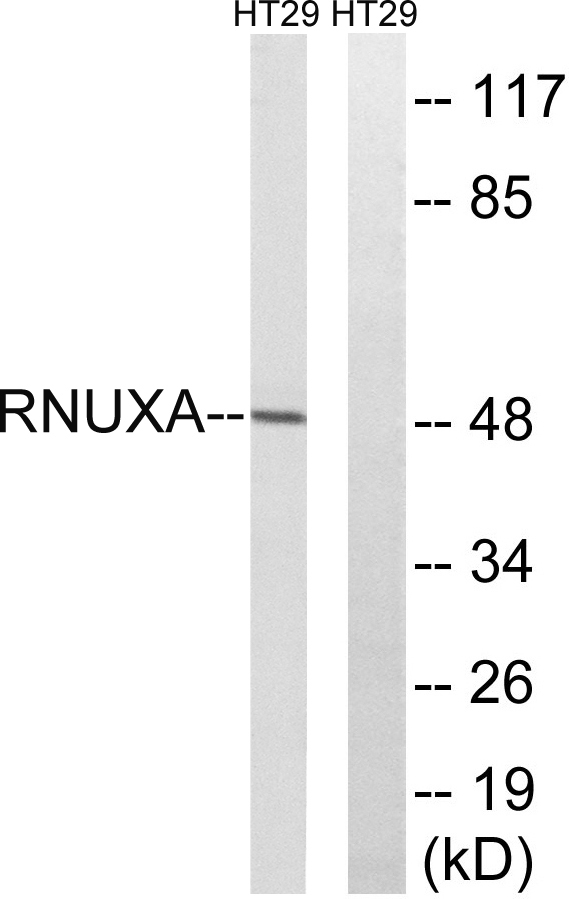
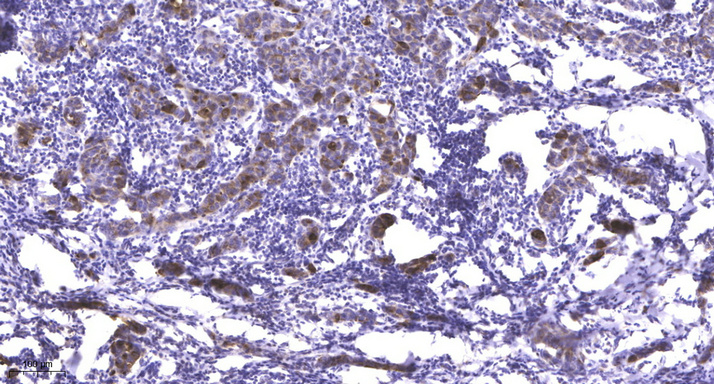

Anti-PHAX antibody (141-190 aa) (STJ95061)
SPECIFICATIONS
ClonalityPolyclonal
HostRabbit
ConjugationUnconjugated
IsotypeIgG
ImmunogenThe antiserum was produced against synthesized peptide derived from the human RNUXA at the amino acid range 141-190
General Information
| Short Description | Rabbit polyclonal anti-Phosphorylated adapter RNA export protein (141-190 aa) for use in WB, ELISA and IHC in Human, Rat and Mouse samples. Datasheet included with dilution recommendations, and related reagents. |
| Applications | WB/ELISA/IHC |
| Host | Rabbit |
| Reactivity | Human/Rat/Mouse |
| Note | STRICTLY FOR FURTHER SCIENTIFIC RESEARCH USE ONLY (RUO). MUST NOT TO BE USED IN DIAGNOSTIC OR THERAPEUTIC APPLICATIONS. |
Product Properties
| Clonality | Polyclonal |
| Isotype | IgG |
| Conjugation | Unconjugated |
| Concentration | 1 mg/mL |
| Purification | The antibody was affinity-purified from rabbit antiserum by affinity-chromatography using epitope-specific immunogen. |
| Dilution Range | WB 1:500-2000IHC-P 1:50-300ELISA 2000-20000 |
| Formulation | Liquid in PBS containing 50% Glycerol, 0.5% BSA and 0.02% Sodium Azide. |
| Storage Instruction | Store at-20°C for up to 1 year from the date of receipt, and avoid repeat freeze-thaw cycles. |
Target Information
| Gene Symbol | PHAX |
| Gene ID | 51808 |
| Uniprot ID | PHAX_HUMAN |
| Immunogen | The antiserum was produced against synthesized peptide derived from the human RNUXA at the amino acid range 141-190 |
| Immunogen Region | 141-190 aa |
| Specificity | PHAX Polyclonal Antibody detects endogenous levels of PHAX protein. |
Additional Info
| Function | A phosphoprotein adapter involved in the XPO1-mediated U snRNA export from the nucleus. Bridge components required for U snRNA export, the cap binding complex (CBC)-bound snRNA on the one hand and the GTPase Ran in its active GTP-bound form together with the export receptor XPO1 on the other. Its phosphorylation in the nucleus is required for U snRNA export complex assembly and export, while its dephosphorylation in the cytoplasm causes export complex disassembly. It is recycled back to the nucleus via the importin alpha/beta heterodimeric import receptor. The directionality of nuclear export is thought to be conferred by an asymmetric distribution of the GTP- and GDP-bound forms of Ran between the cytoplasm and nucleus. Its compartmentalized phosphorylation cycle may also contribute to the directionality of export. Binds strongly to m7G-capped U1 and U5 small nuclear RNAs (snRNAs) in a sequence-unspecific manner and phosphorylation-independent manner. Also plays a role in the biogenesis of U3 small nucleolar RNA (snoRNA). Involved in the U3 snoRNA transport from nucleoplasm to Cajal bodies. Binds strongly to m7G-capped U3, U8 and U13 precursor snoRNAs and weakly to trimethylated (TMG)-capped U3, U8 and U13 snoRNAs. Also binds to telomerase RNA. |
| Protein Name | Phosphorylated Adapter Rna Export ProteinRna U Small Nuclear Rna Export Adapter Protein |
| Database Links | Reactome: R-HSA-191859Reactome: R-HSA-6807505 |
| Cellular Localisation | NucleusNucleoplasmCajal BodyCytoplasmLocated In The Nucleoplasm And Cajal BodiesShuttles Between The Nucleus And The CytoplasmShuttles Between The Nucleoplasm And Cajal Bodies |
| Alternative Antibody Names | Anti-Phosphorylated Adapter Rna Export Protein antibodyAnti-Rna U Small Nuclear Rna Export Adapter Protein antibodyAnti-PHAX antibodyAnti-RNUXA antibody |
Information sourced from Uniprot.org