
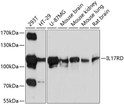


Anti-IL17RD antibody (150-300) (STJ112071)
SPECIFICATIONS
ClonalityPolyclonal
HostRabbit
ConjugationUnconjugated
IsotypeIgG
General Information
| Short Description | Rabbit polyclonal IL17RD (150-300) antibody for use in WB and ELISA in human, mouse and rat samples. Datasheet included with dilution recommendations, and related reagents. |
| Applications | WB/ELISA |
| Host | Rabbit |
| Reactivity | Human/Mouse/Rat |
| Note | STRICTLY FOR FURTHER SCIENTIFIC RESEARCH USE ONLY (RUO). MUST NOT TO BE USED IN DIAGNOSTIC OR THERAPEUTIC APPLICATIONS. |
Product Properties
| Clonality | Polyclonal |
| Isotype | IgG |
| Conjugation | Unconjugated |
| Concentration | Lot specific |
| Purification | Affinity purification |
| Dilution Range | WB:1:500-1:2000ELISA:Recommended starting concentration is 1 Mu g/mL. Please optimize the concentration based on your specific assay requirements. |
| Formulation | PBS with 0.02% Sodium Azide, 50% Glycerol, pH 7.3. |
| Storage Instruction | Store at-20°C for up to 1 year from the date of receipt, and avoid repeat freeze-thaw cycles. |
Target Information
| Gene Symbol | IL17RD |
| Gene ID | 54756 |
| Uniprot ID | I17RD_HUMAN |
| Immunogen Region | 150-300 |
| Immunogen Sequence | FLNMKFETDYFVKVVPFPSI KNESNYHPFFFRTRACDLLL QPDNLACKPFWKPRNLNISQ HGSDMQVSFDHAPHNFGFRF FYLHYKLKHEGPFKRKTCKQ EQTTETTSCLLQNVSPGDYI IELVDDTNTTRKVMHYALKP VHSPWAGPIRA |
| Specificity | Recombinant fusion protein containing a sequence corresponding to amino acids 150-300 of human IL17RD (NP_060033.3). |
Additional Info
| Tissue Specificity | Expressed in umbilical vein endothelial cells and in several highly vascularized tissues such as kidney, colon, skeletal muscle, heart and small intestine. Highly expressed in ductal epithelial cells of salivary glands, seminal vesicles and the collecting tubules of the kidney. Isoform 1 is also highly expressed in both fetal and adult brain, pituitary, tonsils, spleen, adenoids, fetal kidney, liver, testes and ovary. Isoform 1 is also expressed at moderate levels in primary aortic endothelial cells and adrenal medulla, and at low levels in adrenal cortex. Isoform 4 is specifically and highly expressed in pituitary, fetal brain and umbilical vein endothelial cells. |
| Function | Feedback inhibitor of fibroblast growth factor mediated Ras-MAPK signaling and ERK activation. Regulates the nuclear ERK signaling pathway by spatially blocking nuclear translocation of activated ERK without inhibiting cytoplasmic phosphorylation of ERK. Mediates JNK activation and may be involved in apoptosis. May inhibit FGF-induced FGFR1 tyrosine phosphorylation. Might have a role in the early stages of fate specification of GnRH-secreting neurons. Inhibits TGFB-induced epithelial-to-mesenchymal transition in lens epithelial cells. |
| Protein Name | Interleukin-17 Receptor DIl-17 Receptor DIl-17rdIl17rhomInterleukin-17 Receptor-Like ProteinSef HomologHsef |
| Database Links | Reactome: R-HSA-5674135 |
| Cellular Localisation | Golgi Apparatus MembraneSingle-Pass Type I Membrane ProteinCell MembranePredominantly Associated With The Golgi Apparatus And Is Partially Translocated To The Plasma Membrane Upon StimulationIsoform 4: Cytoplasm |
| Alternative Antibody Names | Anti-Interleukin-17 Receptor D antibodyAnti-Il-17 Receptor D antibodyAnti-Il-17rd antibodyAnti-Il17rhom antibodyAnti-Interleukin-17 Receptor-Like Protein antibodyAnti-Sef Homolog antibodyAnti-Hsef antibodyAnti-IL17RD antibodyAnti-IL17RLM antibodyAnti-SEF antibodyAnti-UNQ6115 antibodyAnti-PRO20026 antibody |
Information sourced from Uniprot.org