
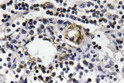


Anti-IFNG antibody (20-69 aa) (STJ93644)
SPECIFICATIONS
ClonalityPolyclonal
HostRabbit
ConjugationUnconjugated
IsotypeIgG
ImmunogenThe antiserum was produced against synthesized peptide derived from the human IFN-gamma at the amino acid range 20-69
General Information
| Short Description | Rabbit polyclonal anti-Interferon gamma (20-69 aa) for use in WB, IHC, IF and ELISA in Human, Rat and Mouse samples. Datasheet included with dilution recommendations, and related reagents. |
| Applications | WB/IHC/IF/ELISA |
| Host | Rabbit |
| Reactivity | Human/Rat/Mouse |
| Note | STRICTLY FOR FURTHER SCIENTIFIC RESEARCH USE ONLY (RUO). MUST NOT TO BE USED IN DIAGNOSTIC OR THERAPEUTIC APPLICATIONS. |
Product Properties
| Clonality | Polyclonal |
| Isotype | IgG |
| Conjugation | Unconjugated |
| Concentration | 1 mg/mL |
| Purification | The antibody was affinity-purified from rabbit antiserum by affinity-chromatography using epitope-specific immunogen. |
| Dilution Range | WB 1:500-1:2000IHC 1:100-1:300ELISA 1:40000IF 1:50-200 |
| Formulation | Liquid in PBS containing 50% Glycerol, 0.5% BSA and 0.02% Sodium Azide. |
| Storage Instruction | Store at-20°C for up to 1 year from the date of receipt, and avoid repeat freeze-thaw cycles. |
Target Information
| Gene Symbol | IFNG |
| Gene ID | 3458 |
| Uniprot ID | IFNG_HUMAN |
| Immunogen | The antiserum was produced against synthesized peptide derived from the human IFN-gamma at the amino acid range 20-69 |
| Immunogen Region | 20-69 aa |
| Specificity | IFN-Gamma Polyclonal Antibody detects endogenous levels of IFN-Gamma protein. |
Additional Info
| Post Translational Modifications | Proteolytic processing produces C-terminal heterogeneity, with proteins ending alternatively at Gly-150, Met-157 or Gly-161. |
| Function | Type II interferon produced by immune cells such as T-cells and NK cells that plays crucial roles in antimicrobial, antiviral, and antitumor responses by activating effector immune cells and enhancing antigen presentation. Primarily signals through the JAK-STAT pathway after interaction with its receptor IFNGR1 to affect gene regulation. Upon IFNG binding, IFNGR1 intracellular domain opens out to allow association of downstream signaling components JAK2, JAK1 and STAT1, leading to STAT1 activation, nuclear translocation and transcription of IFNG-regulated genes. Many of the induced genes are transcription factors such as IRF1 that are able to further drive regulation of a next wave of transcription. Plays a role in class I antigen presentation pathway by inducing a replacement of catalytic proteasome subunits with immunoproteasome subunits. In turn, increases the quantity, quality, and repertoire of peptides for class I MHC loading. Increases the efficiency of peptide generation also by inducing the expression of activator PA28 that associates with the proteasome and alters its proteolytic cleavage preference. Up-regulates as well MHC II complexes on the cell surface by promoting expression of several key molecules such as cathepsins B/CTSB, H/CTSH, and L/CTSL. Participates in the regulation of hematopoietic stem cells during development and under homeostatic conditions by affecting their development, quiescence, and differentiation. |
| Protein Name | Interferon GammaIfn-GammaImmune Interferon |
| Database Links | Reactome: R-HSA-877300Reactome: R-HSA-877312Reactome: R-HSA-8877330Reactome: R-HSA-8950505Reactome: R-HSA-9732724 |
| Cellular Localisation | Secreted |
| Alternative Antibody Names | Anti-Interferon Gamma antibodyAnti-Ifn-Gamma antibodyAnti-Immune Interferon antibodyAnti-IFNG antibody |
Information sourced from Uniprot.org