

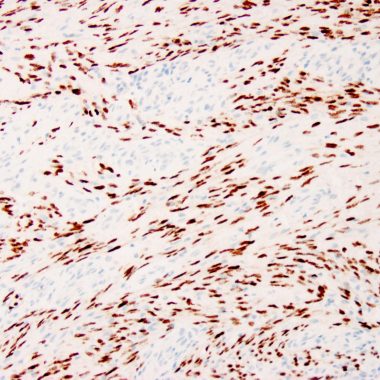

Anti-HHV-8 antibody [ZR106] (STJ180387)
SPECIFICATIONS
ClonalityMonoclonal
HostRabbit
ConjugationUnconjugated
IsotypeIgG
ImmunogenRecombinant protein corresponding to the latent nuclear antigen 1 molecule of HHV8
General Information
| Short Description | Rabbit monoclonal HHV-8 antibody for use in IHC-P in hhv8 samples. Datasheet included with dilution recommendations, and related reagents. |
| Applications | IHC-P |
| Host | Rabbit |
| Reactivity | HHV8 |
| Note | STRICTLY FOR FURTHER SCIENTIFIC RESEARCH USE ONLY (RUO). MUST NOT TO BE USED IN DIAGNOSTIC OR THERAPEUTIC APPLICATIONS. |
Product Properties
| Clonality | Monoclonal |
| Clone ID | ZR106 |
| Isotype | IgG |
| Conjugation | Unconjugated |
| Purification | Affinity purified |
| Dilution Range | 1:100-200 |
| Formulation | Tris-HCI buffer containing stabilizing protein (BSA) and <0.1% ProClin |
| Storage Instruction | Store at 2‐8°C for up to 24 months. Predilute: Ready to use, no reconstitution necessary. Concentrate: Use dilution range and appropriate lab‐standardized diluent. Stability after dilution: 7 days at 24°C, 3 months at 2‐8°C, 6months at ‐20°C. |
Target Information
| Immunogen | Recombinant protein corresponding to the latent nuclear antigen 1 molecule of HHV8 |
| Specificity | Positive control: Kaposi's sarcoma |
Additional Info
| Background | HHV8 encodes a latent nuclear antigen (LNA) , which is the product of the viral gene orf 73. LNA is capable of forming a complex with retinoblastoma susceptibility gene product, which may be related to its oncogenic activity. HHV8 is associated with three different diseases observed in AIDS patients; Kaposi s sarcoma, primary effusion lymphoma (which is a rare type of non-Hodgkin lymphoma affecting the body cavities) and multicentric Castleman s disease. HHV8 is the likely etiological agent of Kaposi s sarcoma. |
Information sourced from Uniprot.org